
Government Sector Waste Management in KSA: Meeting Vision 2030 Sustainability Goals
-
Home
-
Environment
-
Government Sector Waste Management in KSA: Meeting Vision 2030 Sustainability Goals
Government Sector Waste Management in KSA: Meeting Vision 2030 Sustainability Goals
Saudi Arabia has set some of the most ambitious waste management targets in the world. Driven by Vision 2030, the government has committed to transforming the Kingdom from one of the highest per-capita waste generators in the region into a circular economy leader.

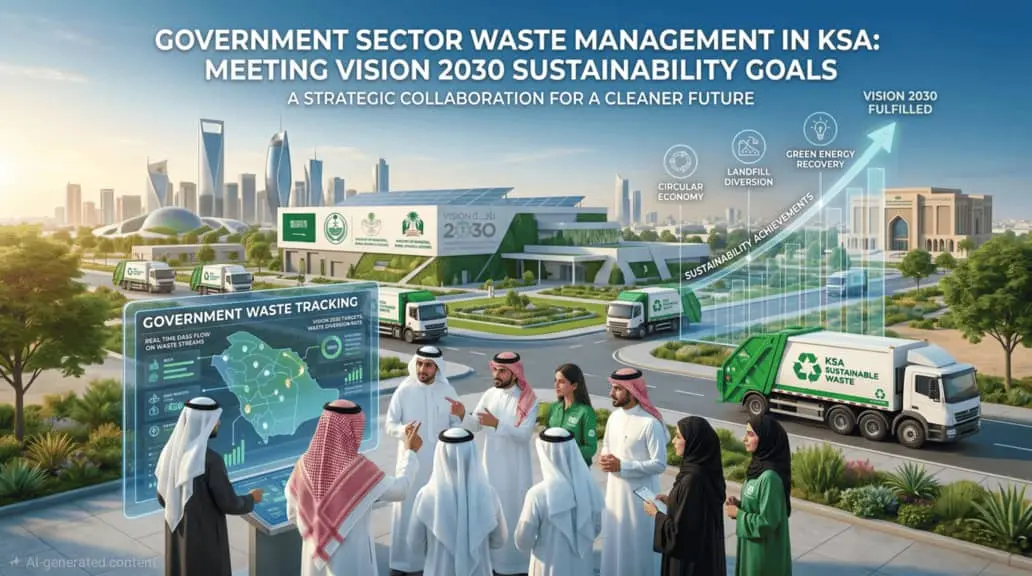
Saudi Arabia has set some of the most ambitious waste management targets in the world. Driven by Vision 2030, the government has committed to transforming the Kingdom from one of the highest per-capita waste generators in the region into a circular economy leader. For government entities, public institutions, and the contractors and service providers who support them, this transformation is not a distant policy aspiration — it is an active compliance obligation with real enforcement consequences.
The government sector sits at the centre of Saudi Arabia's waste challenge and its solution. Government entities are among the largest waste producers in the Kingdom — generating municipal solid waste, construction and demolition debris, sewage sludge, healthcare waste, and general operational waste at scale. At the same time, government institutions are legally required to contract with MWAN-licensed service providers, demonstrate compliance with the 2021 Waste Management Law, and actively contribute to the Kingdom's national landfill diversion targets.
This guide provides a comprehensive overview of what the Vision 2030 waste targets mean in practice for government entities, what the law requires of public sector waste producers and their contractors, the waste streams that matter most, and how to select a compliant waste management partner capable of supporting your organisation's sustainability obligations.
1. The Scale of the Challenge: Saudi Arabia's Waste Generation Reality
Saudi Arabia faces a waste generation challenge that is significant by any measure. The Kingdom currently generates more than 50 million tonnes of municipal solid waste annually, with per-capita generation among the highest in the region — Riyadh alone records waste generation rates above 1.5 kilograms per person per day. Food waste costs the economy an estimated SAR 40 billion (USD 10.6 billion) annually, with food loss and waste hitting 33 percent.
The construction boom driven by Vision 2030 mega-projects — NEOM, the Red Sea Project, Diriyah, Qiddiya, and hundreds of government infrastructure initiatives — is adding massively to the construction and demolition waste stream. Jeddah Municipality alone received nearly 5 million tonnes of waste in the first half of 2025, of which 3.9 million tonnes was construction and demolition debris. E-waste generation is growing rapidly, with Saudi Arabia among the largest generators globally at 620 million kilograms annually — around 85% of which currently ends up in landfills.
The environmental cost is quantifiable. Solid waste causes environmental damage estimated at USD 1.3 billion annually. The Kingdom currently has more than 230 landfills across its regions — most not engineered to limit environmental impact — and strategic priorities have decisively shifted from expanding landfill capacity to eliminating it.
2. Vision 2030 Waste Targets: What the Government Has Committed To
The government's commitment to waste transformation under Vision 2030 is specific, measurable, and backed by law. Understanding the targets is essential context for every government entity managing waste or procuring waste services.
MWAN's National Waste Management Strategy — Key Targets
Divert 90% of all waste from landfills by 2040
Divert 82% of municipal solid waste from landfills by 2035
Divert 85% of industrial waste from landfills by 2035
Divert 60% of construction and demolition waste from landfills by 2030
Achieve a national recycling rate of 40% across waste streams
Reduce per-capita waste generation by 3% annually
Generate 3 gigawatts of electricity from waste-to-energy capacity by 2030
Reduce CO₂-equivalent emissions by 177% from the 2021 baseline through improved waste management
Establish 840 treatment and recovery facilities across the Kingdom by 2040
These targets represent a fundamental transformation from current reality. In 2024, the proportion of waste diverted from landfills reached 18% — MWAN itself described this as notable progress, but it underlines the distance still to travel. With the recycling rate currently at approximately 15%, far below the global average of 30%, the pace of change must accelerate dramatically.
Investment opportunities in Saudi Arabia's waste management sector are estimated at SAR 420 billion (USD 112 billion) by 2040, with the private sector as the primary driver. Government entities that position themselves as proactive, compliant waste producers — and that contract with capable, licensed service partners — will be ahead of the curve as this investment flows into the sector.
The Saudi Green Initiative Connection
The Kingdom's waste management transformation is directly linked to the Saudi Green Initiative — the national sustainability programme announced by HRH Prince Mohammed bin Salman in 2021. The Initiative's commitments include planting 10 billion trees, restoring 40 million hectares of degraded land, and reducing carbon emissions by more than 278 million tonnes annually. Improved waste management — reducing landfill methane emissions, expanding recycling, and developing waste-to-energy capacity — is a core pillar of meeting these climate commitments.
For government entities, this means that waste management performance is increasingly connected to national sustainability reporting, ministry-level performance metrics, and international climate commitments. Poor waste management performance is not just a compliance risk — it creates reputational exposure at the institutional and national level.
3. What the Law Requires of Government Entities
The 2021 Waste Management Law is explicit about the obligations of government entities. These obligations go beyond general waste producer requirements and include specific provisions for public sector compliance.
Article 12: Mandatory Contracting with Licensed Service Providers
Article 12 of the Waste Management Law requires all residential and commercial complexes and government administrative entities to contract with service providers authorised by the National Center for Waste Management. This provision means that every government ministry, department, authority, municipality, and public institution in Saudi Arabia must have a contractual relationship with an MWAN-licensed waste management company — not an informal arrangement, not an unlicensed contractor, and not self-management of waste streams that require licensed handling.
Article 11: Core Obligations of Every Waste Producer
Government entities, like all waste producers, are bound by Article 11 — the foundational obligations that apply to every organisation generating waste in the Kingdom:
Conserve natural resources and reduce waste generation to the lowest possible level
Reuse products before converting materials into waste
Store waste in designated, MWAN-approved locations according to environmental controls
Separate waste at the source to facilitate recycling and safe treatment
Use only MWAN-licensed service providers for transportation and disposal
Submit periodic compliance reports to MWAN on waste transport, treatment, storage, and recycling
Cooperate with government agencies during environmental emergencies
Article 16: Regulatory Reporting for Service Providers to Government
Under Article 16 of the Waste Management Law, service providers contracted with government entities are specifically required to submit regular reports to MWAN on waste activities. This provision creates a direct reporting link between your contracted waste service provider and the national regulator — making the quality and compliance of your contractor's documentation a regulatory matter for your organisation, not just a commercial one.
The Privatisation Mandate: Government as Customer, Not Operator
Under Vision 2030's National Transformation Program, municipal waste management is explicitly identified as one of the sectors targeted for privatisation. The intent is clear: government entities should be intelligent, compliant customers of licensed waste management services — not operators of waste infrastructure. Municipalities in Riyadh, Jeddah, and the Eastern Province are already structured around contracted private sector relationships, and this model is expanding across the Kingdom.
Procurement Law and the Etimad Portal
Government procurement of waste management services — including all MWAN-related tenders — is regulated by Saudi Arabia's Procurement Law, administered by the Ministry of Finance through the Etimad portal. All government waste management contracts must be tendered through this centralised procurement system, and contractor qualification must include verification of MWAN licensing status. The Etimad portal serves as the authoritative repository for all government tenders — including those from Riyadh Municipality, Eastern Province Municipality, Jeddah Development & Urban Regeneration Company, and national government entities.
4. The Waste Streams Government Entities Must Manage
Government entities in Saudi Arabia generate a diverse range of waste streams, each with distinct regulatory requirements. Here is a breakdown of the most significant categories:
Municipal Solid Waste (MSW)
MSW from government offices, public institutions, schools, hospitals, and government-managed facilities is the highest-volume waste stream for most public sector entities. It includes paper, cardboard, plastics, food waste, and general non-hazardous materials. The obligation to separate waste at source — a requirement under Article 11 — means government entities must have separation systems in place, not simply a single waste stream going to a contracted collector. MWAN's strategic focus on recycling and landfill diversion means that bulk collection contracts that simply truck MSW to landfill are no longer adequate from a compliance or sustainability perspective.
Construction and Demolition (C&D) Waste
The volume of C&D waste generated by government infrastructure projects is enormous. Vision 2030 mega-projects, new city development, road and transport infrastructure, public buildings, and ongoing urban renewal are producing millions of tonnes of concrete, brick, metal, wood, and asphalt waste annually. The Ministry of Municipal and Rural Affairs and Housing (MOMRAH) has issued specific guidelines for the disposal of construction, demolition, and renovation waste, requiring transportation to designated disposal sites managed by municipalities. The target of diverting 60% of C&D waste from landfills by 2030 makes compliant disposal planning a core requirement for every government construction project.
Sewage Sludge
Government-managed wastewater treatment facilities produce large volumes of sewage sludge — a regulated waste stream requiring licensed transport and approved treatment or disposal. Sewage sludge from public infrastructure is subject to specific controls under Saudi environmental regulations, and its management must be handled by MWAN-licensed service providers equipped for liquid waste and sludge operations. Improper sludge management is a significant source of regulatory violations across the public sector.
Healthcare Waste
Government hospitals, clinics, primary care centres, and public health facilities generate healthcare waste — one of the most tightly regulated waste categories in the Kingdom. Healthcare waste management in Saudi Arabia requires specific segregation protocols, colour-coded container systems, specialised transport, and approved treatment (typically incineration or autoclaving). The Ministry of Health and MWAN jointly set requirements for healthcare waste management, and government healthcare facilities bear direct responsibility for ensuring their contracted waste providers meet all applicable standards.
General Operational Waste from Government Facilities
Beyond the major waste categories, government facilities generate a constant stream of operational waste: spent fluorescent lamps and electronic equipment (WEEE), used cooking oil from government cafeterias, waste tires from government vehicle fleets, spent batteries, and general maintenance waste. Many of these streams are classified as special waste under MWAN regulations and require separate handling — they cannot simply be consolidated into general solid waste collections.
5. The Circular Economy Imperative: Beyond Disposal to Resource Recovery
Vision 2030's waste framework is explicitly built on circular economy principles — the idea that waste is not a problem to be disposed of, but a resource to be recovered, recycled, and reintroduced into productive use. For government entities, this shifts the frame from 'waste disposal' to 'resource management.'
Saudi Investment Recycling Company (SIRC)
SIRC — established by the Public Investment Fund as the largest industrial waste management company in the GCC — is the Kingdom's primary vehicle for waste recycling and resource recovery at scale. Government entities can engage with SIRC for industrial and hazardous waste recycling, and the company's expanding infrastructure is designed to support the Kingdom's recycling targets across multiple waste streams.
Waste-to-Energy (WtE)
Saudi Arabia has committed to generating 3 gigawatts of electricity from waste-to-energy capacity by 2030, with SIRC leading investment in WtE plants. Government entities whose waste streams include significant quantities of non-recyclable combustible materials have a clear pathway under the national strategy — and WtE infrastructure is expanding. In Jubail, a sustainable utilities plant converting industrial waste into steam, cooled water, and compressed air is already operational, with further projects across the Kingdom.
Extended Producer Responsibility (EPR)
Article 14 of the Waste Management Law introduces extended producer responsibility — the principle that producers and importers bear responsibility for the full lifecycle of their products, including end-of-life recovery. Government procurement policies that favour EPR-compliant products, and government facilities that actively participate in take-back and recycling programmes, directly support the circular economy infrastructure that the Kingdom is building.
Food Waste Reduction
Food waste from government cafeterias, event facilities, military installations, schools, and hospitals represents a major, often underestimated waste stream. Saudi Arabia's annual food waste cost of SAR 40 billion underlines the economic as well as environmental imperative. The Ministry of Municipality and Rural Affairs issued a decree requiring restaurants and wedding halls to contract with food banks to manage excess food — a precedent that government facility managers can apply proactively within their own operations.
6. Equipment Rental: A Practical Solution for Government Project Waste
One of the most common practical challenges for government entities managing large-scale infrastructure, construction, or public events is the availability of appropriate waste containment and collection infrastructure at project sites. Equipment rental — including roll-off dumpsters, compactors, and specialty waste containers — is a flexible, cost-effective solution that eliminates capital expenditure on infrastructure that government projects need temporarily but not permanently.
Roll-off dumpsters and skip containers
Ideal for construction site waste collection, major facility cleanouts, public event waste management, and temporary waste accumulation points at government project sites. Available in multiple capacities to match project waste volumes, and transported directly to approved disposal or treatment facilities by licensed contractors.
Compactors
High-volume government facilities — hospitals, universities, large office complexes, military bases — benefit from on-site waste compactors that reduce collection frequency, lower transport costs, and support source separation of recyclable streams. Compactor rental eliminates capital expenditure while providing access to appropriately specified equipment.
Specialty containers for hazardous and regulated waste
Government facilities generating healthcare waste, chemical waste, used oil, fluorescent lamps, electronic waste, or construction waste requiring separate collection need appropriately specified containers — colour-coded, sealed, and labelled according to MWAN requirements. Rental of specialty containers through a licensed waste service provider ensures regulatory compliance from point of generation.
7. Choosing a Compliant Waste Partner for Government Sector Operations
For government entities procuring waste management services through the Etimad portal or direct contracting arrangements, the choice of service partner carries regulatory, reputational, and financial implications. Here is the framework for evaluating potential contractors:
Current MWAN licensing across all required service categories
Verify that your contractor holds valid MWAN licenses covering every waste management activity required by your organisation — collection, transportation, treatment, and disposal for each waste category you generate. A contractor licensed only for general solid waste cannot legally handle healthcare waste, hazardous materials, or sludge. Request current license documentation and cross-check with MWAN's licensed entities database.
Capability to support regulatory reporting
Under Article 16, service providers contracted to government entities must submit regular reports to MWAN. Your contractor must have the systems, documentation practices, and reporting capability to meet this obligation. Ask specifically what reporting formats they use, what frequency reports are submitted, and whether you receive copies of all MWAN submissions.
Source separation and recycling support
A contractor that simply consolidates all waste into a single stream and trucks it to landfill is not consistent with the Kingdom's 2030 and 2035 diversion targets — or with your organisation's obligations under Article 11. Your waste partner should be able to provide source separation guidance, appropriate collection containers for different waste streams, and documented recycling and diversion outcomes.
Construction and demolition waste competency
If your organisation generates C&D waste — as virtually all government entities involved in construction or facility management do — your contractor must understand MOMRAH's disposal requirements, operate permitted vehicles for C&D waste transport, and direct waste to designated disposal sites. C&D waste management is one of the highest-scrutiny areas for government entities.
Sewage tanker and liquid waste capability
Government infrastructure projects, public facilities, and remote government sites frequently require sewage tanker operations for liquid waste and sludge removal. Ensure your waste contractor holds MWAN authorisation for liquid waste transport and that their tanker fleet meets specification requirements.
Track record with government and public sector clients
Government waste management has specific procurement, documentation, and reporting requirements that differ from commercial or industrial contracts. A contractor with demonstrated experience supporting government ministries, municipalities, military facilities, or public healthcare organisations will be better positioned to meet the administrative and compliance demands of public sector contracting.
Zero Waste International Company Ltd. provides comprehensive waste management services for government entities, public sector organisations, and government-contracted projects across Saudi Arabia. Our services span non-hazardous waste transport and disposal, sewage tanker operations, super sucker and vacuum services, equipment rental (roll-off containers, compactors, and specialty containers), and tank cleaning — all delivered by MWAN-licensed teams with the documentation and reporting capability that government contracting requires. We help government organisations meet their Vision 2030 sustainability obligations while maintaining full regulatory compliance.
Related Posts

Learn how Saudi businesses can safely manage industrial waste removal, including hazardous waste cla...
How Saudi Arabia regulates construction and demolition waste in 2026 — the Waste Management Law, MWA...
Choosing a waste management company in Saudi Arabia is not a procurement decision you can make on pr...