
Waste Management Regulations in Saudi Arabia
-
Home
-
Waste Removal
-
Waste Management Regulations in Saudi Arabia: What Businesses Must Know in 2026
Waste Management Regulations in Saudi Arabia: What Businesses Must Know in 2026
Saudi Arabia generates more than 110 million tonnes of waste annually, and the government has set bold sustainability targets as part of Vision 2030. To achieve these targets, the Kingdom has built a comprehensive legal framework that governs every aspect of waste management — from the moment waste is produced to its final disposal.

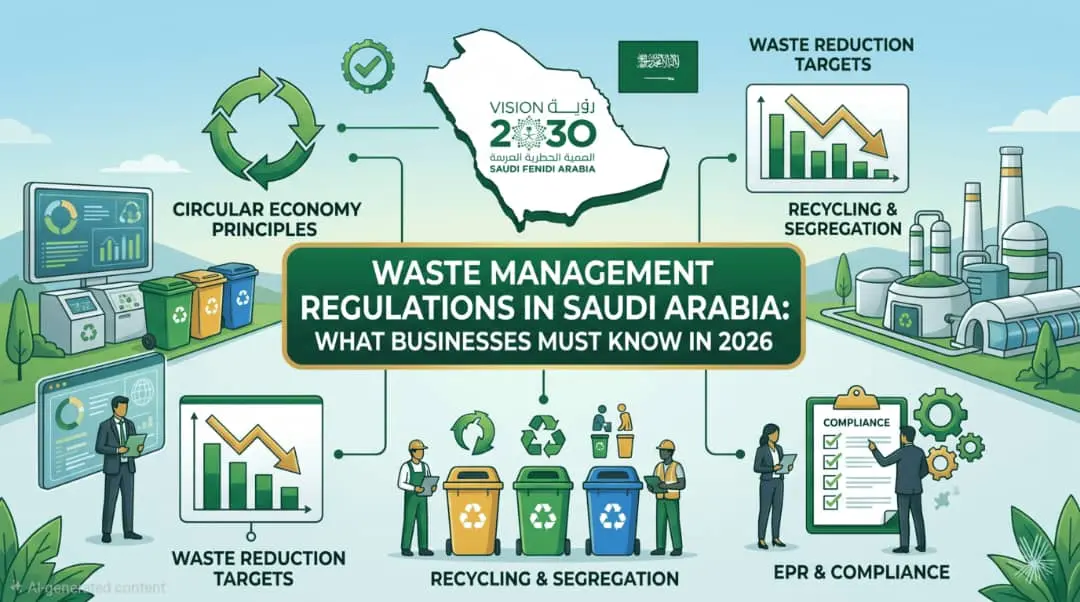
Saudi Arabia's waste sector is undergoing one of the most significant regulatory transformations in its history. If your business generates, transports, or manages waste in the Kingdom, compliance is no longer optional — it is a legal obligation with serious financial and operational consequences.
Saudi Arabia generates more than 110 million tonnes of waste annually, and the government has set bold sustainability targets as part of Vision 2030. To achieve these targets, the Kingdom has built a comprehensive legal framework that governs every aspect of waste management — from the moment waste is produced to its final disposal. This guide breaks down everything businesses operating in Saudi Arabia need to know to stay compliant in 2025.
1. The Saudi Waste Management Law (2021): The Foundation of Compliance
The cornerstone of Saudi Arabia's regulatory framework is the Waste Management Law, issued by Royal Decree and Council of Ministers decision on August 13, 2021. This law replaced the older Municipal Solid Waste Management Law of 2013 and came into full effect on November 14, 2021.
The law consists of 38 articles and covers the full lifecycle of waste, including:
Collection, transportation, sorting, and storage
Treatment, recycling, import, and export
Safe disposal and aftercare of disposal sites
Civil and criminal liability for waste producers and service providers
Importantly, the law applies to all businesses that produce or manage waste — regardless of sector. Whether you operate in oil and gas, manufacturing, FMCG, ports, or government services, you are a 'waste producer' under this law and have specific legal obligations.
2. Who Enforces the Law? Understanding the Regulatory Bodies
Saudi Arabia has multiple government bodies responsible for waste regulation. Knowing which authority governs your business activity is the first step to compliance.
National Center for Waste Management (MWAN)
MWAN is the primary regulatory authority for all waste management activities in the Kingdom. Established in 2019, MWAN is responsible for:
Issuing licenses and permits to all waste service providers
Preparing the national strategic plan for waste management
Setting standards, controls, and requirements for every waste category
Imposing fines and administrative penalties for violations
Overseeing the circular economy principle across all waste streams
National Center for Environmental Compliance (NCEC)
The NCEC issues environmental licensing and accreditation for organizations providing environmental services. If your company offers environmental services related to waste, you may need NCEC accreditation in addition to an MWAN license.
Ministry of Environment, Water and Agriculture (MEWA)
MEWA sets the overarching environmental policy framework and issues implementing regulations under the Waste Management Law. The Minister of MEWA chairs the MWAN Board of Directors.
3. Hazardous vs. Non-Hazardous Waste: What the Law Says
One of the most critical distinctions under the 2021 law is the classification of waste into hazardous and non-hazardous categories. The obligations, handling requirements, and penalties are significantly different between the two.
Hazardous Waste
Under the law, hazardous waste is defined as waste generated from industrial or non-industrial activities that contains toxic, flammable, reactive, or corrosive materials — including solvents, degreasers, oils, dyes, pigments, acids, and alkalis. This category is common in:
Oil and gas operations (drilling fluids, produced water, contaminated soil)
Power plants (chemical waste, fuel residue)
Ports (marine vessel waste, oily bilge water)
Manufacturing and industrial facilities
Businesses handling hazardous waste must:
Separate hazardous waste at the source
Use MWAN-licensed transporters only
Maintain detailed transportation records and documentation
Ensure hazardous waste vehicles do not pass through residential areas during restricted hours
Notify competent authorities of transport routes and any changes
Non-Hazardous Waste
Non-hazardous waste includes general solid waste, construction and demolition debris, dry bulk materials, and industrial byproducts that do not require specialized chemical handling. While the handling requirements are less stringent than for hazardous waste, businesses must still use licensed service providers and comply with storage and disposal standards.
4. What Businesses Are Required to Do: Key Obligations Under Article 11
Article 11 of the Waste Management Law sets out the core obligations of every waste producer operating in Saudi Arabia. Compliance is not optional — these are legal requirements:
Conserve natural resources and reduce waste generation to the lowest possible level
Reuse products before converting materials into waste
Store waste in designated, approved locations according to MWAN environmental controls
Separate waste at the source to facilitate recycling and safe treatment
Use only MWAN-licensed service providers for transportation and disposal
Submit periodic reports to MWAN on waste transport, treatment, storage, and recycling
Cooperate with government agencies during environmental emergencies
Additionally, under Article 14, manufacturers and importers bear extended responsibility for their products — ensuring financial sustainability in the waste management sector and enforcing the concept of a circular economy.
5. Penalties and Fines: The Real Cost of Non-Compliance
Ignorance of the law is not a defense. Saudi Arabia's Waste Management Law carries some of the harshest environmental penalties in the region.
Here is a breakdown of the key penalties businesses should be aware of:
Criminal penalties (Article 29)
Disposing of, storing, burning, treating, or dumping waste in any manner that poses a risk to public health or damages the environment carries:
Imprisonment for up to 10 years
A fine of up to SAR 30 million (approximately USD 8 million)
Or both penalties simultaneously
An additional daily fine of up to 10% of the base fine for each day a violation continues
Doubled penalties for repeat offenders within three years
Administrative fines
Transferring waste to a service provider without verifying their legal authorization: up to SAR 10 million
Non-compliance with hazardous waste separation requirements: SAR 10,000 to SAR 100,000
Failure to remove construction or demolition waste from a site: SAR 5,000 to SAR 20,000
Dumping construction waste on public land: up to SAR 50,000
Operating without an MWAN license or permit: license suspension, cancellation, or fines up to SAR 10 million
Repeat violators face doubled fines. The law also allows courts to confiscate equipment used in violations and impose ongoing daily fines until the violation is corrected.
6. Licensing: No Activity Without Authorization
One of the most important provisions of the 2021 law is straightforward: no activity related to waste management may be practiced without obtaining a license or permit from MWAN. This applies to:
Waste collection and transportation companies
Waste treatment and disposal facilities
Recycling operations
Any facility handling, storing, or processing waste commercially
For businesses that hire waste contractors, the law places clear responsibility on you to verify that any service provider holds valid MWAN authorization. Using an unlicensed contractor is itself a violation and can result in fines of up to SAR 10 million.
7. Vision 2030 and the Tightening Regulatory Environment
Saudi Arabia's ambitious sustainability goals under Vision 2030 are directly driving the enforcement of waste regulations. MWAN's National Waste Management Strategy has set targets for 2040 that include:
Diverting 90% of all waste from landfills
Achieving a 40% recycling rate across waste streams
Reducing per-capita waste generation by 3% annually
Cutting annual CO₂ equivalent emissions by 177% from the 2021 baseline
These targets mean that regulatory enforcement is only going to intensify. The Saudi waste management market is forecast to grow at a compound annual growth rate of 7.4% between 2025 and 2032 — and with this growth comes closer scrutiny of business compliance.
Investment opportunities in the sector are estimated at SAR 420 billion, and the government is actively building the infrastructure — including 800+ new waste management and resource recovery facilities — to meet its goals.
8. How to Choose a Compliant Waste Management Partner
For businesses that generate waste, one of the most effective ways to protect your operations is to partner with a licensed, experienced waste management company. Here is what to look for:
Verify MWAN licensing
Any legitimate waste contractor must hold a valid license from the National Center for Waste Management. Do not rely on verbal assurances — request documentation and check MWAN's registry.
Check service coverage
Ensure the company is authorized for the specific waste types you generate. A company licensed for non-hazardous waste cannot legally handle hazardous materials.
Assess documentation practices
Your contractor should provide proper transportation records, manifests, and periodic reports — documentation you will need to demonstrate compliance if audited.
Evaluate emergency response capability
Incidents happen. A reliable waste partner should have the equipment and protocols to respond to emergency spills, leaks, or unexpected waste volumes without putting your operations or compliance at risk.
Look for sector-specific experience
Waste requirements differ significantly between oil and gas, ports, FMCG, and government projects. A partner with proven experience in your industry understands the specific regulatory requirements and operational challenges you face.
Zero Waste International Company Ltd. is a licensed waste management provider serving businesses across Saudi Arabia's industrial, government, and private sectors. With expertise in hazardous and non-hazardous waste transport, tank cleaning, contaminated soil remediation, super sucker services, and equipment rental, we help you stay compliant, protect your operations, and meet your environmental obligations.
Related Posts

Learn how Saudi businesses can safely manage industrial waste removal, including hazardous waste cla...
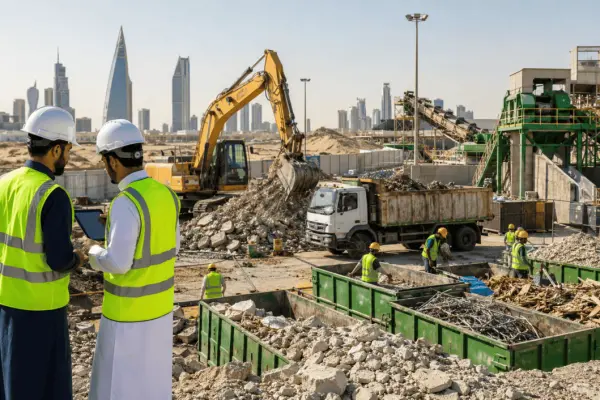
How Saudi Arabia regulates construction and demolition waste in 2026 — the Waste Management Law, MWA...
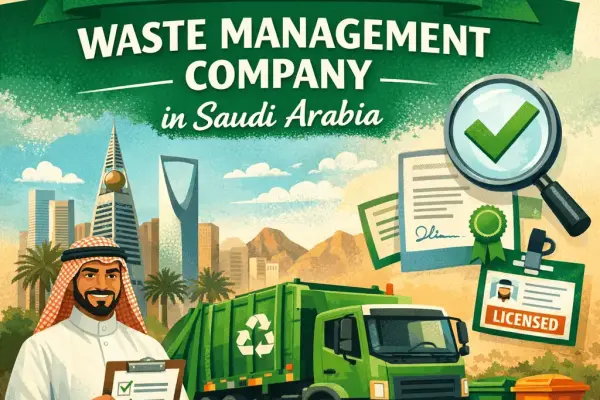
Choosing a waste management company in Saudi Arabia is not a procurement decision you can make on pr...