

Waste Management for FMCG Companies in Saudi Arabia: Staying Compliant and Cost-Efficient
-
Home
-
Environment
-
Waste Management for FMCG Companies in Saudi Arabia: Staying Compliant and Cost-Efficient
Waste Management for FMCG Companies in Saudi Arabia: Staying Compliant and Cost-Efficient
Saudi Arabia's FMCG sector is one of the largest and fastest-growing consumer markets in the Middle East. As a major producer and consumer of packaged foods, beverages, personal care products, and household goods, the sector generates a substantial and diverse waste stream.

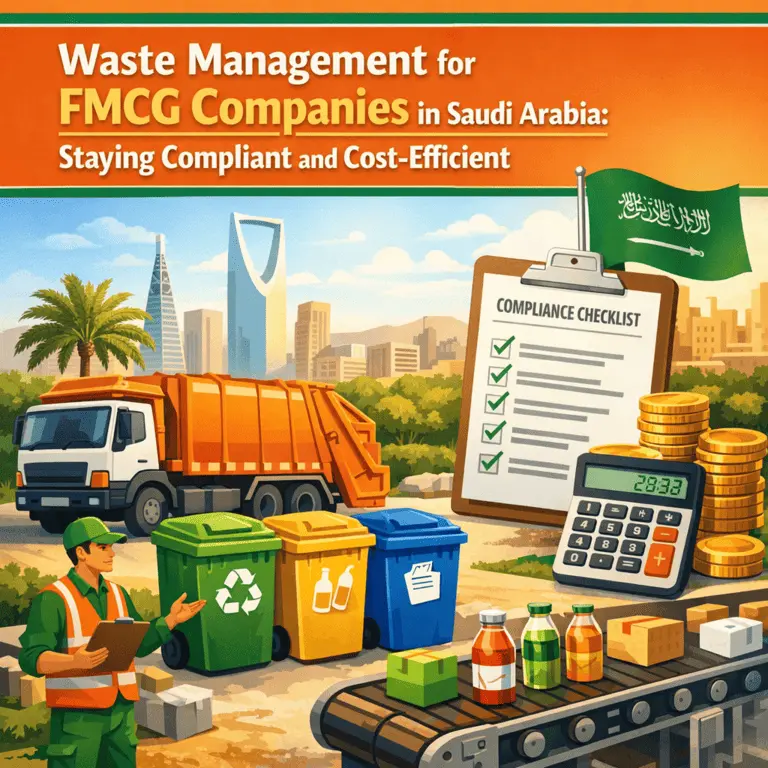
Saudi Arabia's FMCG sector is one of the largest and fastest-growing consumer markets in the Middle East. As a major producer and consumer of packaged foods, beverages, personal care products, and household goods, the sector generates a substantial and diverse waste stream — and faces a tightening regulatory environment that makes proper waste management both a legal imperative and a business performance issue.
FMCG companies in Saudi Arabia — whether multinational manufacturers with local production facilities, regional producers, or large-scale distributors — are subject to the full requirements of the 2021 Waste Management Law, SFDA food safety regulations governing waste disposal at food manufacturing sites, and SASO packaging compliance requirements. At the same time, they face commercial pressures to control operational costs, minimize product waste, and demonstrate environmental credentials to international partners, retail buyers, and an increasingly sustainability-conscious Saudi consumer base.
This guide covers the waste streams that FMCG operations generate, the regulatory framework that applies, the cost-efficiency case for structured waste management, and the practical solutions — including high-capacity hauling and container rental — that help FMCG companies stay compliant without disrupting operations.
1. The FMCG Waste Challenge in Saudi Arabia: Scale and Diversity
Saudi Arabia's FMCG sector sits within the largest grocery market in the Gulf Cooperation Council. Driven by a young, digitally engaged population of over 35 million and per-capita consumption rates that are among the highest in the region, the sector generates waste at scale across every point in the supply chain — from raw material intake and manufacturing through packaging, distribution, and end-of-life product handling.
Food waste alone represents a major challenge. Saudi Arabia generates more than 50 million tonnes of municipal solid waste annually, with food waste responsible for an estimated SAR 40 billion (USD 10.6 billion) in annual economic losses — with a food loss and waste rate of 33%. For FMCG manufacturers and distributors, this waste originates from overproduction, quality rejects, expired inventory, production line losses, and packaging defects that remove product from the saleable chain. The Saudi food waste management market reached USD 0.73 billion in 2024 and is forecast to grow at a CAGR of 5.25% through 2033 — reflecting both the scale of the problem and the growing investment in solutions.
Beyond food waste, FMCG operations generate a diverse waste portfolio that spans multiple regulatory categories. Unlike many industrial sectors where waste streams are more uniform, FMCG manufacturing combines food production waste, packaging materials waste, chemical and cleaning agent residues, wastewater, and general operational waste — often simultaneously across a single production facility. Managing this diversity compliantly and cost-efficiently requires a structured approach.
2. The Waste Streams FMCG Operations Generate
Food Production Waste and Organic Byproducts
Every stage of food and beverage manufacturing generates organic waste: raw material trimmings, production line rejects, expired or out-of-specification product, cooking byproducts, wash water containing food residues, and edible oil waste from frying and cooking operations. In Saudi Arabia, organic waste from food manufacturers is subject to SFDA technical requirements that mandate regular disposal to prevent pest infestation and cross-contamination — specifically, SFDA's Technical Requirements for Food and Water Manufacture require that waste is disposed of regularly so that it does not become a source of pests, and that cleaning and disinfecting of containers and sewer lines is conducted regularly.
Organic food production waste can also represent a resource recovery opportunity: anaerobic digestion can convert food organic waste into biogas and digestate; composting converts it into soil amendments; and rendering processes recover oils and protein from animal-derived production waste. FMCG companies that develop documented food waste reduction and diversion programmes align with Vision 2030's sustainability requirements and may benefit from lower disposal costs where treatment alternatives are available.
Packaging Waste — Primary, Secondary, and Tertiary
Packaging waste is one of the highest-volume waste streams in FMCG operations. It arises from three levels: primary packaging (consumer-facing containers, bottles, cans, pouches, wrappers in direct contact with the product), secondary packaging (boxes, cartons, shrink wrap, trays used to group primary packages), and tertiary packaging (pallets, stretch wrap, strapping used for logistics). At the manufacturing level, packaging waste includes off-specification packaging materials, print rejects, damaged containers, and packaging generated during line changeovers.
Saudi Arabia's regulatory framework for packaging waste is multi-layered. SASO certification requirements for food contact materials mandate that packaging materials meet safety standards and that recyclable and eco-friendly materials are used wherever possible. SFDA packaging compliance requirements include waste management guidelines requiring proper disposal and recycling practices. The 2021 Waste Management Law's Extended Producer Responsibility (EPR) provisions — under Article 14 — place lifecycle responsibility on manufacturers and importers for the packaging they place on the market, including end-of-life recovery. As EPR schemes are implemented in practice, FMCG companies face increasing obligations to demonstrate take-back and recycling compliance for their packaging.
Chemical Cleaning and Sanitisation Waste
Food and beverage manufacturing facilities require rigorous cleaning and sanitisation programmes — a hygiene imperative imposed by both SFDA regulations and international food safety standards such as FSSC 22000, BRCGS, and ISO 22000. These cleaning programmes generate significant volumes of chemical waste: spent sanitisers, caustic cleaning solutions, acid wash effluents, disinfectant residues, and contaminated cleaning equipment. Many of these chemical residues are classified as industrial waste under MWAN's categories, and some may be classified as hazardous depending on concentration and chemical composition. All must be handled by licensed service providers and disposed of through approved treatment pathways — not discharged to drains or mixed with general solid waste.
Wastewater and Production Effluents
Food and beverage manufacturing generates wastewater streams that are distinct from domestic sewage: wash water containing food residues, sugars, fats, and cleaning chemicals; condensate from evaporation and cooking processes; cooling tower blowdown; and boiler blowdown. SFDA requirements for food manufacturing facilities mandate the provision of a primary treatment unit for wastewater positioned away from the manufacturing area. Wastewater discharge must comply with Saudi environmental standards, and facilities generating significant volumes of process effluent may require a wastewater pre-treatment system and an operating permit from the relevant regulatory authority.
Solid Non-Hazardous Waste — General and Dry Bulk
Day-to-day operations at FMCG facilities generate large volumes of general solid waste: cardboard, paper, plastic film, broken pallets, metal strapping, foam packaging, and administrative waste. In distribution centres and warehouses, damaged goods, expired inventory, and recalled product add to the general waste volume. High-capacity collection and hauling — using roll-off dumpsters, compactors, and scheduled collection services — is essential to prevent waste accumulation that creates pest and hygiene risks, compromises warehouse safety, and can trigger regulatory non-compliance findings during SFDA facility inspections.
Returned Products and Recall Waste
FMCG companies managing product returns, shelf withdrawals, and quality recalls face a specific waste management challenge: the need to dispose of branded product in a way that prevents it from re-entering the supply chain while meeting waste classification and disposal requirements. Expired food products, contaminated lots, mislabelled goods, and recalled personal care or household products all require documented disposal with a clear audit trail. This is not a waste stream that can be managed through informal channels — SFDA and MWAN both require traceable, compliant disposal for food products removed from sale.
3. The Regulatory Framework FMCG Companies Must Navigate
FMCG companies in Saudi Arabia operate under a layered regulatory framework that combines waste management law with food safety regulations and packaging requirements. Compliance failure in any one layer creates exposure across the others.
The Waste Management Law (2021) — Core Obligations
All FMCG manufacturers, distributors, and large-scale retailers are waste producers under the 2021 Waste Management Law and are subject to its core obligations under Article 11: separating waste at source, storing waste in approved locations, using only MWAN-licensed service providers for transport and disposal, and submitting periodic compliance reports. The mandatory contracting requirement under Article 12 means that FMCG facilities cannot informally manage waste streams — every collection and disposal activity must be under contract with a licensed provider. Using an unlicensed waste contractor exposes the FMCG operator to fines of up to SAR 10 million.
SFDA Technical Requirements for Food Manufacturing Facilities
SFDA's Technical Requirements for Food and Water Manufacture impose specific waste management obligations on food production facilities registered in Saudi Arabia. Key requirements include: regular disposal of waste to prevent it becoming a source of pests; regular cleaning and disinfection of waste containers and sewer lines; provision of a primary wastewater treatment unit at appropriate distance from the manufacturing area; and proper separation and storage of chemicals away from food production areas. These requirements are enforced through SFDA facility inspections — and non-compliance findings can result in suspension of manufacturing licences and product registration withdrawal.
SASO Certification and Packaging Waste Requirements
Saudi Arabia's Standards, Metrology and Quality Organization (SASO) certification requirements for food packaging mandate that businesses adopt recyclable and eco-friendly packaging materials wherever possible, and comply with waste management guidelines requiring proper disposal and recycling practices. FMCG companies exporting to or manufacturing within Saudi Arabia must ensure that their packaging waste management practices align with SASO sustainability requirements — not just as a compliance matter, but because SASO certification is a market access prerequisite.
Extended Producer Responsibility (EPR)
Article 14 of the Waste Management Law introduces EPR as a foundational principle — requiring manufacturers and importers to assume responsibility for the end-of-life management of the products and packaging they place on the market. Saudi Arabia's EPR framework is still being developed in implementation regulations, but the direction is clear: FMCG companies will be expected to fund and demonstrate take-back, recycling, and recovery programmes for their packaging. Companies that build EPR-compatible waste management practices now will be ahead of the curve when implementation regulations are enforced.
Food Waste — Ministry of Municipality Decree
The Ministry of Municipality and Rural Affairs has issued a decree requiring restaurants and food service establishments to contract with food banks to preserve excess food rather than disposing of it as waste. While this currently targets food service rather than manufacturing, the policy direction is clear — and proactive FMCG companies that develop documented food waste reduction and diversion programmes position themselves favourably as this framework extends to the production sector.
4. The Cost-Efficiency Case for Structured Waste Management
For FMCG companies facing margin pressure in one of the region's most competitive consumer markets, the instinct can be to treat waste management as a cost to minimise. The reality is that unstructured, reactive waste management is significantly more expensive than a planned, contracted approach — and the financial consequences of non-compliance compound the direct disposal costs.
The true cost of reactive waste management
When waste accumulates at a facility between irregular collection events, it creates cascading costs: additional labour for manual handling and redistribution, pest management costs triggered by organic waste accumulation, emergency collection premiums for unplanned pickups, and regulatory risk from non-compliant storage. For food manufacturing facilities subject to SFDA inspection, accumulated waste is one of the most common triggers for compliance findings — findings that can escalate to licence suspension if not resolved. The cost of a suspended manufacturing licence for even a single week far exceeds the annual cost of a properly structured waste collection contract.
Compaction and volume reduction
For FMCG facilities generating high volumes of cardboard, plastic film, and light packaging waste, an on-site compactor can reduce waste volume by 60-80% compared to loose collection. This directly reduces collection frequency — and collection frequency drives cost. A facility paying for three waste collections per week from a standard skip container may require only one collection per week with a compactor, at significantly lower total disposal cost. Compactor rental through a licensed waste service provider eliminates capital expenditure while capturing the volume reduction and collection frequency benefit.
Source separation and recycling revenue
Unstructured waste management treats all waste as disposal cost. Structured source separation creates the possibility of recycling revenue. Cardboard, clean plastic film, glass, and metal generated by FMCG operations have market value as recyclables — with the right source separation system, these materials can be diverted from disposal (a cost) into recycling (which generates revenue or at minimum reduces net disposal cost). Saudi Arabia's recycling infrastructure is expanding rapidly under Vision 2030 — the number of MWAN-licensed entities in the sector reached 1,348 by 2024, including 145 recycling facility permits — creating more options for FMCG companies to convert waste streams into value.
Avoiding the fine exposure
The 2021 Waste Management Law's penalty structure creates significant financial exposure for FMCG companies with unmanaged waste practices. Fines for using unlicensed contractors reach SAR 10 million; fines for failure to separate hazardous from non-hazardous waste range from SAR 10,000 to SAR 100,000; repeat violations are doubled; and SFDA facility licence suspension for waste non-compliance can cost a manufacturing facility orders of magnitude more in lost production than the fine itself. Against this exposure, the cost of a fully compliant, contracted waste management programme is modest.
Sustainability and commercial positioning
Saudi Arabia's consumer base is evolving rapidly — younger, more digitally engaged, and increasingly sustainability-aware. Major retailers including Panda, Carrefour, and Tamimi are already requiring suppliers to demonstrate environmental credentials and waste management practices as part of supplier qualification. International buyers, export partners, and regional distribution agreements increasingly include sustainability requirements. FMCG companies that build documented, verifiable waste management programmes aligned with Vision 2030 targets position themselves ahead of competitors who treat compliance as a box-ticking exercise.
5. Practical Solutions: High-Capacity Hauling and Container Rental for FMCG Operations
For FMCG companies, the operational requirement is straightforward: waste must be collected frequently enough to prevent accumulation, in sufficient volumes to handle peak production periods, with compliant documentation, and at cost structures that fit operational budgets. Here is how the right service mix achieves this:
High-Capacity Roll-Off Dumpsters
Roll-off dumpsters — typically 6 to 30 cubic metre capacity — are deployed at FMCG manufacturing facilities, distribution centres, and large warehouses as primary waste accumulation points. They provide the volume capacity to handle peak production days without overflow, can be scheduled for collection at appropriate frequencies, and are available in configurations for both mixed solid waste and separated recyclable streams. Roll-off rental from a licensed waste service provider means the FMCG operator does not own the asset — maintenance, regulatory compliance, and transport are all the responsibility of the service provider.
On-Site Compactors
Industrial compactors — either stationary baler-compactors for recyclables or self-contained compactors for general solid waste — are the highest-impact waste management investment for FMCG facilities generating large volumes of cardboard, plastic film, or mixed solid waste. Renting rather than purchasing a compactor provides access to appropriately specified equipment without capital commitment, with maintenance included in the service agreement. A certified waste service provider managing both the compactor rental and the collection frequency optimises the full waste removal cost.
Specialty Containers for Regulated Waste Streams
FMCG facilities generating chemical cleaning waste, edible oil waste, wastewater sludge, or recalled product requiring documented disposal need appropriately specified containers — sealed, labelled, and compliant with MWAN requirements for each waste category. Specialty container rental through a licensed provider ensures that each regulated waste stream is collected in compliant containers, transported by licensed vehicles, and disposed of through approved treatment pathways — with documentation at every step.
Scheduled High-Capacity Hauling
For FMCG distribution centres, cold chain facilities, and large warehouses handling product returns, expired inventory, and general operational waste, high-capacity hauling — using large-volume vehicles capable of removing significant tonnages per collection visit — reduces the number of collections required, the administrative burden of managing multiple smaller pickups, and the per-tonne cost of disposal. Scheduling hauling to align with production cycles — higher collection frequency during peak production periods, lower frequency during slower periods — allows FMCG companies to match waste management costs with production volume.
Sewage Tanker and Liquid Waste Services
Food and beverage manufacturing facilities generating significant volumes of wastewater, edible oil effluent, or cleaning chemical waste that cannot be discharged to the sewage network require sewage tanker and liquid waste collection services. A licensed provider with sewage tanker capability ensures that liquid waste from food manufacturing is removed compliantly, transported to approved treatment facilities, and documented — preventing the regulatory risk associated with improper liquid waste disposal at food manufacturing sites.
6. Choosing a Waste Partner That Understands FMCG
Not all waste management companies understand the specific requirements of FMCG and food manufacturing environments. The right partner for an FMCG company in Saudi Arabia combines MWAN licensing and compliance capability with practical knowledge of food facility requirements.
MWAN licensing verified for each waste category
Your waste contractor must hold MWAN authorisation for every waste category your facility generates — non-hazardous solid waste, chemical waste, liquid waste, and any hazardous categories arising from cleaning chemicals or production byproducts. Verify the licence scope independently.
Understanding of SFDA facility requirements
A contractor working at a food manufacturing site must understand SFDA hygiene and waste disposal requirements — including the frequency of waste removal needed to prevent pest risk, proper container specifications for food facility environments, and the documentation standards required to support an SFDA inspection record.
Collection frequency flexibility
FMCG production is cyclical — daily and weekly waste volumes vary significantly with production schedules. Your waste service partner must be able to adjust collection frequency up and down with production demands, provide emergency collections when unplanned waste volumes arise, and maintain contractual SLAs that prevent accumulation during peak periods.
Source separation and recycling programme support
A waste service provider that helps your facility implement source separation — providing appropriate containers for each waste stream, advising on recyclable material preparation, and creating documentation of diversion rates — adds value beyond basic collection. This support helps FMCG companies demonstrate compliance with Article 11's source separation obligation and build the recycling performance data needed for EPR reporting as those requirements come into force.
Documented disposal chain for product recall and returns
For product recall and return disposal, documentation is non-negotiable. Your waste service provider must be able to provide destruction certificates, waste manifests, and volume records for every consignment of recalled or returned product disposed of — protecting your company against liability for recalled product re-entering the supply chain.
Zero Waste International Company Ltd. provides comprehensive non-hazardous waste transport and disposal, equipment rental (roll-off dumpsters, compactors, and specialty containers), and liquid waste services for FMCG manufacturers, distributors, and food production facilities across Saudi Arabia. Our MWAN-licensed teams deliver the collection frequency, documentation standards, and regulatory compliance knowledge that FMCG operations in the Kingdom require — helping you manage waste costs, protect your SFDA operating licence, and meet your Vision 2030 sustainability obligations.
Contact Zero Waste International — get a tailored waste management plan for your FMCG facility.
Related Posts

Learn how Saudi businesses can safely manage industrial waste removal, including hazardous waste cla...
How Saudi Arabia regulates construction and demolition waste in 2026 — the Waste Management Law, MWA...
Choosing a waste management company in Saudi Arabia is not a procurement decision you can make on pr...