

Tank Cleaning for Power Plants in Saudi Arabia: Best Practices and Safety Standards
-
Home
-
Environment
-
Tank Cleaning for Power Plants in Saudi Arabia: Best Practices and Safety Standards
Tank Cleaning for Power Plants in Saudi Arabia: Best Practices and Safety Standards
Saudi Arabia's power generation capacity is scaling at an exceptional pace. The market is expected to grow from 83 gigawatts in 2023 to over 110 gigawatts by 2028 — a CAGR of 5.8% — with the Ministry of Energy's spending on power and renewable energy projects projected to reach USD 293 billion by 2030.

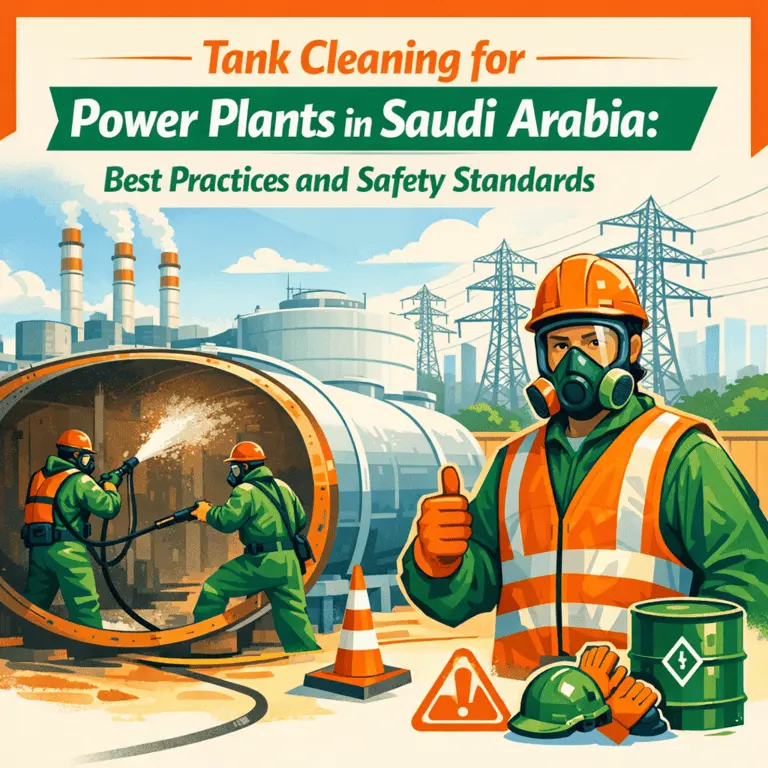
A power plant's tank is not simply a storage vessel — it is a critical infrastructure asset whose condition directly determines the plant's operational efficiency, safety profile, regulatory standing, and generating reliability. In Saudi Arabia's rapidly expanding power sector, the consequences of deferred or inadequate tank cleaning ripple across every dimension of plant performance. This guide covers what tank cleaning involves for power generation facilities, why it matters, the safety standards that govern it, and how to choose the right service partner for your plant.
Saudi Arabia's power generation capacity is scaling at an exceptional pace. The market is expected to grow from 83 gigawatts in 2023 to over 110 gigawatts by 2028 — a CAGR of 5.8% — with the Ministry of Energy's spending on power and renewable energy projects projected to reach USD 293 billion by 2030. Alongside this expansion, the Kingdom is transitioning its generation mix toward renewables, targeting 50% of electricity from renewable sources by 2030. Both the legacy thermal fleet and the incoming renewables infrastructure bring significant tank maintenance requirements that cannot be deferred without operational and safety consequences.
1. The Tank Ecosystem in a Saudi Power Plant
Power plants — whether gas-fired combined cycle, oil-fired steam turbine, cogeneration, or the growing renewable-plus-storage configurations — operate a complex ecosystem of tanks, each serving a distinct function and generating distinct maintenance and cleaning requirements. Understanding the full tank inventory at a power plant is the starting point for any maintenance planning exercise.
Fuel Storage Tanks
The most critical and the most challenging tanks at any thermal power plant. Saudi Arabia's gas and oil-fired plants store heavy fuel oil, diesel, and gas condensate in large above-ground storage tanks (ASTs), typically designed and built to API 650 standards. These tanks accumulate bottom sediment — a dense, viscous mixture of water, scale, wax, asphaltenes, and heavy hydrocarbon residue — that progressively reduces usable storage volume, degrades fuel quality, promotes microbial growth, and causes internal corrosion that threatens structural integrity. In extreme heat conditions — routinely above 45°C at many Saudi plant sites — the sludge layer in a fuel tank can harden into a near-solid mass, making removal without professional equipment extremely difficult.
Cooling Water Tanks and Reservoirs
Cooling systems are the thermal backbone of any steam-based power plant. Large cooling water storage tanks, open reservoirs, and cooling tower basins accumulate biological growth (algae, biofilm, Legionella-risk bacteria), scale deposits from mineral-rich Saudi water supplies, silt and sand contamination (particularly significant in desert environments), and corrosion byproducts. Uncleaned cooling tanks reduce heat transfer efficiency — a direct hit to plant thermal efficiency and generating output — and present microbiological risks that are tightly regulated under Saudi environmental and health standards.
Demineralised Water (DM Water) Tanks
DM water is the lifeblood of steam generation in thermal power plants — used in boilers and heat recovery steam generators (HRSGs) to produce steam with controlled chemistry. DM water tanks require periodic cleaning to remove biofilm, iron oxides, scale deposits, and any contamination introduced during tank maintenance or repair. Failure to maintain DM water tank cleanliness compromises boiler chemistry, accelerates boiler tube corrosion, and risks forced outages — one of the highest-cost maintenance events in any power plant.
Chemical Storage Tanks
Power plants use large volumes of treatment chemicals: corrosion inhibitors, biocides, scale inhibitors, demineralisation regenerants (sulphuric acid, caustic soda), cooling tower chemicals, and wastewater treatment agents. The tanks storing these chemicals require regular inspection and cleaning to remove residues, prevent cross-contamination, and maintain the structural integrity of tank linings. Chemical tank cleaning is a high-hazard activity requiring specialist PPE, chemical compatibility knowledge, and strict confined space entry protocols.
Wastewater and Effluent Tanks
Power plants generate significant volumes of wastewater: boiler blowdown, cooling tower blowdown, chemical regeneration effluents, and storm water runoff contaminated with oils and chemicals from plant operational areas. Collection tanks, sludge sumps, and equalisation basins accumulate solid deposits, chemical scale, and biological material that must be removed periodically to maintain treatment system capacity and regulatory compliance.
Lube Oil and Hydraulic Fluid Tanks
Gas turbines, steam turbines, generators, and large rotating equipment operate large lube oil systems with dedicated storage tanks. These tanks accumulate moisture, metallic wear particles, oxidation products, and varnish deposits that degrade oil quality and risk equipment damage. Lube oil tank cleaning is a precision task that requires complete drainage, solvent flushing, and inspection before fresh oil charge — and any contamination left in the tank immediately degrades the new oil charge.
2. Why Tank Cleaning Is Mission-Critical for Power Plant Performance
The business case for regular, professional tank cleaning in a power plant is not difficult to make — the cost of deferred cleaning is almost always higher than the cost of the cleaning itself.
Operational Efficiency
Sludge and scale accumulation in fuel tanks reduces usable storage volume — in severely degraded tanks, bottom sediment can account for 10-20% of total tank capacity. Scale deposits in cooling systems reduce heat transfer rates, forcing turbines and condensers to operate less efficiently and at higher thermal stress. Contaminated DM water compromises boiler chemistry, requiring more chemical dosing and risking accelerated tube degradation. Every efficiency loss translates directly into higher fuel consumption and lower generating output for the same fixed cost base.
Asset Life and Corrosion Prevention
Tanks are expensive capital assets. API 653 — the standard for Tank Inspection, Repair, Alteration, and Reconstruction — requires that aboveground storage tanks be periodically inspected internally, which requires the tank to be taken out of service, degassed, and cleaned. Deferred cleaning accelerates the corrosion cycle: accumulated water in the bottom of fuel tanks creates a corrosive electrolytic interface, and biological activity in the water phase generates hydrogen sulphide and organic acids that attack the tank floor. In Saudi Arabia's extreme heat, this corrosion can progress rapidly. A tank that is properly cleaned and inspected on schedule may require only localised floor plate repairs; the same tank neglected for an additional maintenance cycle may require complete floor replacement — a far more expensive intervention.
Fuel Quality and Equipment Protection
Fuel contaminated with sediment, water, or microbial growth causes downstream equipment problems: clogged burner nozzles, damaged fuel pump internals, fouled heat exchangers, and unpredictable combustion performance. In a gas turbine, a contaminated fuel delivery event can cause compressor surge, combustion instability, or blade erosion — damages that run into millions of riyals per incident. Regular fuel tank cleaning ensures that the fuel delivered to plant equipment meets specification.
Regulatory and Environmental Compliance
Tank leaks and failures are the most significant source of soil and groundwater contamination risk at power plant sites. Saudi Arabia's Environmental Law and MEWA regulations impose specific obligations on facility operators to prevent, detect, and remediate soil contamination from tank leaks. API 653 inspection compliance is also increasingly referenced in Saudi industrial facility regulatory frameworks. Maintaining a documented cleaning and inspection schedule is the first line of evidence of proactive compliance management.
3. The Hazards: Why Tank Cleaning Demands Specialist Expertise
Tank cleaning in power plant environments is one of the highest-risk industrial activities. Attempting it without qualified personnel, proper equipment, and documented safety procedures is a direct threat to worker life. Every year, workers are killed globally in confined space incidents — the vast majority of which are preventable with proper planning and protocols.
The specific hazards in power plant tank environments include:
Oxygen Deficiency
The atmosphere inside a closed tank that has stored hydrocarbons, chemicals, or biological material may be severely oxygen-deficient. Combustion of residual fuel vapours, microbial respiration, and chemical reactions all consume oxygen. An atmosphere with less than 19.5% oxygen is classified as oxygen-deficient under OSHA standards; below 16%, loss of consciousness occurs rapidly; below 6%, death is almost immediate. Oxygen deficiency is invisible, odourless, and provides no warning — atmospheric testing before entry is mandatory, not optional.
Toxic Gases
Hydrogen sulphide (H₂S) is the most dangerous toxic gas encountered in power plant tank environments — generated by sulphate-reducing bacteria in stored fuel and water, and also present in gas condensate and heavy fuel oil residues. H₂S at 10 ppm causes eye and respiratory irritation; at 100 ppm, it causes rapid incapacitation; at 500 ppm, it is immediately fatal. Benzene, present in fuel residues, is a known carcinogen with regulated exposure limits. Carbon monoxide from combustion residues, ammonia from chemical tanks, and chlorine from cooling water treatment chemicals are additional toxic gas hazards specific to power plant environments.
Fire and Explosion
Fuel storage tanks and lube oil tanks contain flammable vapours that create explosive atmospheres. The lower explosive limit (LEL) for hydrocarbon vapours typically falls between 1-2% of atmospheric volume — concentrations easily reached inside a tank containing residual fuel. Any ignition source — a spark from a tool, static electricity, a non-intrinsically-safe torch — in an explosive atmosphere can cause a catastrophic explosion. Tank cleaning operations must be conducted with intrinsically safe equipment, full degassing and ventilation, continuous LEL monitoring, and hot work permit systems.
Engulfment and Entrapment
Sludge and semi-solid sediment at the bottom of fuel and wastewater tanks present a real engulfment risk. Workers entering tanks with significant sludge accumulation have been trapped and asphyxiated when the sludge shifted around them. Proper assessment of sludge consistency and volume before entry, appropriate entry equipment, and a retrieval system are required to manage this hazard.
Heat Stress
In Saudi Arabia, tank interiors during summer maintenance windows can reach temperatures of 55–60°C or higher — even with ventilation. Workers in full chemical protective equipment face acute heat stress risk in these conditions. Work-rest cycles, hydration protocols, atmospheric cooling, and continuous monitoring of worker condition are essential elements of a heat stress management plan for any tank cleaning operation in the Kingdom.
4. The Safety Standards and Frameworks That Apply
Tank cleaning in Saudi Arabian power plants sits at the intersection of multiple national and international safety standards. A competent tank cleaning service provider must demonstrate familiarity with all of them.
API 2015 — Requirements for Safe Entry and Cleaning of Petroleum Storage Tanks
The American Petroleum Institute's API 2015 standard is the primary international reference for safe entry and cleaning of petroleum storage tanks. It covers pre-entry inspection, atmospheric testing requirements, degassing procedures, confined space entry protocols, equipment requirements, and emergency procedures. API 2015 is explicitly referenced in OSHA regulations for tank cleaning operations and is widely adopted in Saudi Aramco and major Saudi operator HSE frameworks.
API 653 — Tank Inspection, Repair, Alteration, and Reconstruction
API 653 governs the inspection of existing aboveground storage tanks. It establishes minimum intervals for internal inspection (which requires cleaning to enable), defines the minimum acceptable thickness for tank floors and shells, and sets requirements for inspection documentation. Power plant operators in Saudi Arabia with API 653 inspection obligations cannot meet them without periodic professional tank cleaning that enables proper internal inspection.
OSHA 29 CFR 1910.146 — Permit-Required Confined Spaces
OSHA's Permit-Required Confined Spaces standard establishes the framework for safe confined space entry — including the requirement for written permit programmes, atmospheric testing before and during entry, mechanical ventilation, trained entrants and attendants, designated supervisors, and rescue equipment on standby. While OSHA is a US standard, its confined space entry requirements are adopted directly in Saudi Aramco's safety management system and in the RCER standards applicable to Jubail and Yanbu industrial facilities — making OSHA 1910.146 compliance a de facto requirement for any professional tank cleaning operation in Saudi industrial environments.
NFPA 326 — Standard for the Safeguarding of Tanks and Containers for Entry, Cleaning, or Repair
NFPA 326 addresses the fire and explosion hazards specific to entering, cleaning, or repairing tanks and containers — including the requirements for atmospheric testing, ventilation, removal of flammable materials, and the use of non-sparking tools and intrinsically safe equipment. Power plant fuel and lube oil tanks fall directly within the scope of this standard.
Saudi Aramco Safety Management System and General Instructions (GIs)
For power plants operating within the Saudi Aramco supply chain, or at facilities subject to Aramco safety oversight, Aramco's General Instructions — particularly those governing confined space entry, hot work, equipment isolation, and contractor safety management — apply directly. Aramco's Contractor Safety Management Program requires that service contractors demonstrate compliance with these GIs as a condition of qualification. A tank cleaning contractor that cannot demonstrate Aramco GI compliance will not qualify for work at Aramco-affiliated power plant facilities.
Royal Commission Environmental Regulations (RCER) for Jubail and Yanbu
Power plants operating in Jubail and Yanbu — including Marafiq-managed facilities — are subject to the RCER-2015 standards, which include specific requirements for confined space entry, hazardous substance management, tank inspection and maintenance, and environmental protection during maintenance operations. RCER compliance is a condition of operating in Royal Commission-administered industrial cities.
5. The Tank Cleaning Process: A Step-by-Step Professional Approach
Professional tank cleaning in a power plant environment follows a structured, documented process. Shortcuts at any stage increase risk and compromise the quality of the cleaning outcome.
Stage 1: Pre-Cleaning Planning and Permitting
Before any equipment moves to site, a comprehensive job safety analysis (JSA) is conducted covering all identified hazards. A confined space entry permit is prepared and approved by the facility's permit-to-work authority. All energy sources to the tank — feeds, drains, heating coils, agitators — are identified and locked out/tagged out. A rescue plan is documented and rescue equipment is confirmed on site. All personnel are briefed on the site-specific hazards and emergency procedures.
Stage 2: Product Removal and Initial Degassing
All recoverable product is removed from the tank through fixed product lines, vacuum pumps, or manual extraction, as appropriate. Initial degassing — forced ventilation to dilute and remove residual vapours — begins. Continuous atmospheric monitoring for oxygen content, LEL, H₂S, and benzene is established before any personnel approach the tank openings. Initial atmospheric readings are logged and compared against safe entry thresholds.
Stage 3: Confined Space Entry and Sludge Removal
Once atmospheric conditions meet safe entry criteria — a minimum of 19.5% oxygen, less than 10% LEL, H₂S below the permitted exposure limit — confined space entry is authorised under the permit system. Entry teams work in shift rotations with continuous atmospheric monitoring, continuous communication with the outside attendant, and retrieval equipment immediately available. Sludge and sediment are removed using vacuum equipment, manual shovels, or mechanical scrapers — depending on the consistency and volume of material — and transferred directly to approved waste containers for characterisation and disposal.
Stage 4: Mechanical and Chemical Cleaning
Following sludge removal, the tank interior is cleaned using a combination of techniques selected for the specific tank type and contamination profile: high-pressure hydroblasting (water jetting) to remove scale and hard deposits from walls and floor; hot water washing to mobilise and remove hydrocarbon residues; chemical cleaning with appropriate solvents or degreasers for specific contamination types; and shot blasting where surface preparation for inspection or recoating is required. Rotating jet heads and gamma-jet technology can be deployed for remote cleaning of large tanks without full confined space entry, reducing personnel exposure.
Stage 5: Inspection
A cleaned tank provides the opportunity for internal inspection — which is why cleaning and inspection should always be planned together. Inspection activities include visual assessment of floor, shell, and roof condition; ultrasonic thickness measurement of floor plates and lower shell courses; assessment of internal coatings; inspection of floating roof seals, pontoons, and drain systems; and documentation of any defects requiring repair. The inspection report drives the maintenance scope for the current outage and informs the next inspection interval.
Stage 6: Waste Characterisation and Disposal
All waste removed from the tank — sludge, wash water, chemical residues, used PPE, and contaminated materials — must be characterised by type and classified under MWAN's waste classification system. Fuel tank sludge is classified as hazardous waste under Saudi regulations and requires transport by MWAN-licensed vehicles with full documentation — waste characterisation report, transport manifest, and final disposal certificate. This documentation is your regulatory protection and must be maintained for audit purposes.
Stage 7: Reinstatement and Return to Service
Following completion of cleaning, inspection, and any required repairs or recoating, the tank is reinspected for cleanliness, all confined space entry permits are closed, all energy isolations are removed in the correct sequence, and the tank is returned to service under a documented commissioning procedure. All cleaning activities are recorded in the facility's maintenance management system (CMMS) to support the next maintenance planning cycle.
6. Choosing a Tank Cleaning Partner for Your Saudi Power Plant
Tank cleaning in a power plant environment is not a commodity service. The wrong contractor — unqualified, underequipped, or safety-shortcuts prone — can cause a fatality, trigger an unplanned outage, or produce a cleaning outcome that fails the subsequent inspection. Here is what to look for:
Documented confined space entry competency
Ask for documented evidence of confined space entry training and certification for every worker who will enter your tanks. Entry supervisors should hold API-certified Tank Entry Supervisor qualifications or equivalent. Written confined space entry permit programmes and atmospheric monitoring records from previous jobs should be available on request.
Intrinsically safe equipment and gas monitoring capability
Verify that the contractor's equipment inventory includes multi-gas detectors (O₂, LEL, H₂S, CO as a minimum), intrinsically safe lighting and communication equipment, forced ventilation systems, and retrieval/rescue equipment. Any contractor arriving at a fuel tank cleaning job without continuous gas monitoring capability should not be allowed to proceed.
Hazardous waste management authorisation
Tank cleaning waste from fuel and chemical tanks is hazardous. Your contractor must hold MWAN authorisation for hazardous waste transport and disposal — verify this independently. The documentation chain from waste generation through transport to final disposal must be complete.
Heat stress management protocols
In Saudi Arabia's climate, heat stress is a genuine and potentially fatal risk for workers in full PPE inside tank environments. Ask your contractor how they manage worker heat exposure — work-rest cycles, buddy systems, hydration schedules, emergency cooling, and medical emergency protocols should all be documented.
Compliance with your plant's permit-to-work system
Your plant's permit-to-work (PTW) system governs all high-risk maintenance activities. Your tank cleaning contractor must be fully conversant with your PTW requirements and must integrate their job safety plans and confined space entry permits into your facility's PTW framework. Contractors who resist or circumvent your PTW system present an immediate safety risk.
Sector experience in power generation environments
Power plant tanks have specific characteristics — high operating temperatures, complex chemical environments, large volumes, integrated with critical plant systems — that differ from general industrial storage. A contractor with proven experience cleaning fuel tanks, DM water tanks, chemical vessels, and cooling system infrastructure at power generation facilities will work more safely, more efficiently, and produce better-quality outcomes than a general industrial tank cleaner.
Zero Waste International Company Ltd. provides specialized tank cleaning and sludge removal services for industrial storage tanks, chemical vessels, and fuel reservoirs across Saudi Arabia's power generation, oil and gas, ports, and industrial sectors. Our certified teams manage the complete cleaning process — from pre-entry planning and permitting through confined space entry, mechanical and chemical cleaning, waste characterisation and disposal — delivering compliant, documented outcomes that support your plant's maintenance, inspection, and regulatory obligations.
Contact Zero Waste International — schedule a tank inspection and cleaning consultation for your facility.
Related Posts
Saudi Arabia's FMCG sector is one of the largest and fastest-growing consumer markets in the Middle...
Saudi Arabia has set some of the most ambitious waste management targets in the world. Driven by Vis...
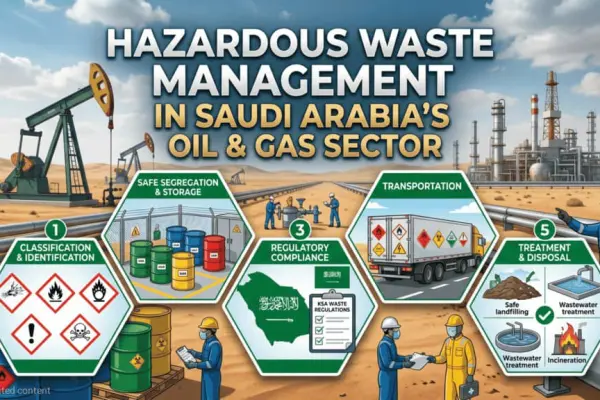
Hazardous waste management in Saudi Arabia's energy sector has entered a new era. The 2021 Waste Man...