
How to Choose a Licensed Waste Management Company in Saudi Arabia
-
Home
-
Waste Removal
-
How to Choose a Licensed Waste Management Company in Saudi Arabia
How to Choose a Licensed Waste Management Company in Saudi Arabia
Choosing a waste management company in Saudi Arabia is not a procurement decision you can make on price alone. Under the 2021 Waste Management Law, organisations that use unlicensed contractors share joint liability for any environmental damage resulting from that waste.

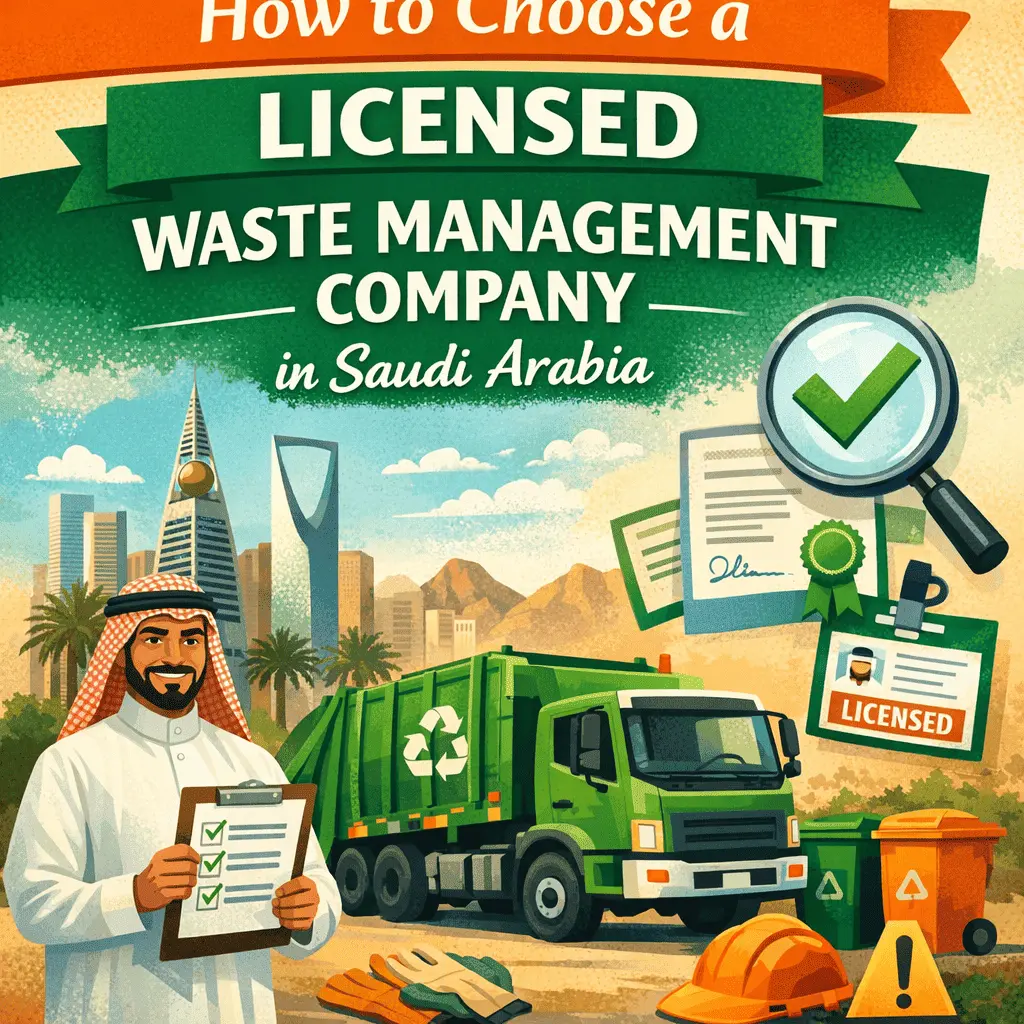
Choosing a waste management company in Saudi Arabia is not a procurement decision you can make on price alone. Under the 2021 Waste Management Law, organisations that use unlicensed contractors share joint liability for any environmental damage resulting from that waste. The wrong choice does not just expose you to higher costs — it exposes you to fines of up to SAR 10 million, regulatory investigation, and criminal liability. This guide gives you a structured framework for evaluating, selecting, and verifying a waste management partner that protects your operations.
Saudi Arabia's waste sector has grown significantly since the 2021 Waste Management Law came into force. As of 2024, MWAN's licensing database counts 1,348 licensed entities in the waste management sector, with an additional 145 permits for recycling facilities — bringing the total to 1,493 investing companies across the Kingdom. The sector is expanding at a CAGR of 7.4%, and the regulatory infrastructure enforcing compliance is expanding with it. Across this growing market, the quality, capability, and compliance status of providers varies enormously. Knowing what to look for is the difference between a partner that protects your business and one that exposes it.
1. Why Your Choice of Waste Contractor Is a Legal Liability Decision
Many businesses approach waste management as a commodity service — a line item on the operational budget where the lowest price wins the tender. This approach fundamentally misunderstands the legal framework governing waste management in Saudi Arabia, and the consequences of getting it wrong.
Joint and Several Liability Under the Waste Management Law
Article 29 of the Saudi Waste Management Law imposes joint and several liability on any party that deposits waste with an unlicensed person. This means that if you hire an unlicensed waste contractor and that contractor illegally dumps your waste, you are legally responsible for the resulting environmental damage — alongside the contractor. You cannot escape liability by pointing to the contractor's responsibility. The law treats you both as jointly liable for the harm caused.
The financial exposure from this provision is significant: criminal fines reach up to SAR 30 million for serious violations, daily continuation fines of up to 10% of the base fine apply for each day a violation continues, and courts can impose remediation costs for environmental damage on top of the criminal penalties. This is not a theoretical risk — MWAN's enforcement capability is expanding, and the electronic waste transport document system being developed will increase the traceability of waste movements across the Kingdom.
Your Own Penalty Exposure as a Waste Producer
Separate from joint liability with your contractor, waste producers face their own direct penalty exposure under the 2021 Law. Failing to use an MWAN-licensed service provider for waste transport and disposal carries a fine of up to SAR 10 million — imposed on you, the waste producer, regardless of whether your contractor also faces penalties. Failure to separate waste at source carries fines of SAR 10,000 to SAR 100,000. All penalties double for repeat violations within three years.
The law is clear: choosing an unlicensed or partially licensed waste contractor does not transfer your liability — it compounds it. Due diligence on contractor licensing status is not optional; it is a legal obligation.
2. The MWAN Licensing Framework: What to Look For
MWAN issues separate licenses and permits for different waste management activities. A contractor licensed for one activity cannot legally perform another. Understanding the licensing structure is essential to verifying that your contractor is properly authorised for everything your waste requires.
License vs. Permit: Understanding the Difference
Under Saudi waste regulations, a license and a permit serve different purposes. A license is the primary authorisation issued to a company to operate as a waste management service provider — it establishes the company's legal standing to conduct waste activities. A permit is a more specific authorisation for a particular activity, facility, or waste type. A contractor may hold a general license but require additional permits to handle specific waste categories — hazardous waste transport, recycling facility operation, or treatment of specific waste streams — separately. Always verify both.
Key License Categories to Verify
Collection and transportation of non-hazardous solid waste — covers general industrial and commercial waste collection
Collection and transportation of hazardous waste — separate authorization required; carries specific vehicle, driver training, route notification, and documentation requirements
Hazardous waste treatment — separate authorization for treatment facilities and specific treatment methods
Hazardous waste disposal — separate authorization for disposal facilities
Recycling facility permit — separate authorization for recycling operations, issued by MWAN before the relevant competent authority issues the facility license
Sewage tanker and liquid waste operations — separate authorization for liquid waste collection and transport
Activity-Specific Scope
A contractor's license must specifically cover the waste types and activities relevant to your operations. A company licensed for non-hazardous solid waste cannot legally handle hazardous waste — even if they offer to do so. A company licensed to transport waste cannot legally treat or dispose of it without separate treatment and disposal authorizations. The scope of each license is specific, and matching the scope to your waste profile is your responsibility as the waste producer.
License Validity
MWAN licenses are time-limited and subject to renewal. A license that was valid when a contractor was first engaged may have expired — or its scope may have changed at renewal. Verify that any license documentation presented is current, that the expiry date is confirmed, and that the scope of the renewed license matches the original. Build license verification into your annual supplier qualification review cycle.
3. How to Verify a Contractor's MWAN License
Verbal assurances of licensing status are not sufficient. Saudi Arabia's legal framework requires you to verify — and MWAN provides the tools to do so.
Request Original License Documentation
Ask your prospective contractor to provide original copies — not photocopies or scanned images — of all MWAN licenses and permits relevant to your waste streams. Review each document for: the issuing authority (must be MWAN), the licensed entity name and commercial registration number, the specific activities authorised, the geographic scope of the license, and the validity dates.
Cross-Check Against MWAN's Licensed Entity Database
MWAN maintains a licensing and permits platform (accessible at mwan.gov.sa) through which waste management licenses are issued electronically and the status of licensed entities can be verified. Use this platform to cross-check the license details provided by your contractor. If a contractor's name, commercial registration, or license number does not appear in MWAN's database, or if the license appears as expired or suspended, do not engage them — regardless of the explanation offered.
Verify the National Center for Environmental Compliance (NCEC) Accreditation
Some environmental service activities — including certain types of environmental consulting, site assessment, and specialised waste treatment — require NCEC accreditation in addition to MWAN licensing. If your waste management requirements include environmental site assessment, contaminated soil remediation, or specialist environmental services, verify NCEC accreditation status alongside MWAN licensing.
Check Commercial Registration and Municipality Approvals
A waste management company in Saudi Arabia must also hold valid commercial registration with the Ministry of Commerce that specifically includes waste management as a listed business activity, and relevant municipality approvals for operating in the areas where they provide service. Request these documents alongside the MWAN license and verify that the business activities listed on the commercial registration are consistent with the services you are procuring.
4. Five Questions to Ask Any Waste Contractor in Saudi Arabia
Beyond licensing verification, a structured due diligence conversation with a prospective waste contractor reveals a great deal about their actual capability and compliance culture. These five questions are designed to separate genuinely compliant, capable providers from companies that pass the licensing check but cannot perform to the required standard.
Question 1: Show me your license for every waste category I generate
A credible contractor will be able to produce license documentation for every waste type in your profile without hesitation. If a contractor is vague about which licenses cover which activities, or suggests that one general license covers everything, this is a warning sign. Push for specific documentation for each waste category: non-hazardous solid waste, hazardous waste transport and disposal, liquid waste, chemical waste, or whatever your operations generate. Any hesitation or gap in their ability to produce specific licenses warrants deeper investigation before you proceed.
Question 2: How do you document and track waste from my site to final disposal?
A compliant waste contractor maintains a documented chain of custody from waste collection at your site through transport, treatment, and final disposal. This documentation includes: collection manifests listing waste type, volume, and origin; transport records with vehicle registration, driver details, and route information; treatment facility receipts; and final disposal certificates. Ask to see examples of these documents from current client relationships. If a contractor cannot show you what their documentation chain looks like, they cannot protect you in the event of a regulatory audit.
Question 3: What happens if there is an emergency spill or unplanned waste event at my facility?
Emergency response capability is a defining characteristic of a serious waste management provider. Ask specifically: What is your response time for an emergency callout? What equipment can you deploy on short notice? Do you have hazardous spill response capability? How do you handle regulatory notification in the event of an environmental incident? A contractor that cannot answer these questions concretely does not have an emergency response programme — and in a Saudi port, industrial facility, or manufacturing plant, that is a significant operational and regulatory risk.
Question 4: What experience do you have in my specific sector and waste type?
Waste management requirements differ fundamentally between oil and gas, FMCG, government, power plants, and ports. A contractor with broad general waste experience but no specific expertise in your sector will not understand the regulatory nuances, the operational constraints, or the documentation requirements specific to your industry. Ask for references from clients in your sector, and specifically from clients with similar waste profiles to your own. Demonstrated sector experience is not optional — it is how you assess whether a contractor can actually deliver what they say they can.
Question 5: Are you prepared to integrate with our permit-to-work and reporting systems?
For industrial facilities, government entities, and organisations with their own HSE management systems, a waste contractor must be able to work within your operational frameworks — including permit-to-work systems, site induction requirements, contractor HSE documentation, and the reporting formats required by your regulators or internal management. A contractor that cannot or will not integrate with your systems is not a suitable partner for a compliance-sensitive operation.
5. Red Flags: Warning Signs of an Unlicensed or Non-Compliant Operator
In a growing market with significant regulatory enforcement gaps, non-compliant waste operators exist — and they actively compete on price. Recognising the warning signs can protect your business from a liability exposure that far exceeds any short-term cost saving.
Red flags that should end any contractor evaluation immediately:
Unable to produce original MWAN license documentation — offers photocopies, verbal assurances, or promises to provide documentation later
License scope does not match the waste types they are offering to service — claims a general license covers all activities
Pricing that is significantly below market — illegal operators eliminate the cost of licensed disposal by dumping waste illegally, which is how they undercut compliant providers
No documented chain of custody — cannot show examples of waste manifests, transport records, and disposal certificates from existing clients
Vague or evasive answers about disposal methods — 'we take care of everything' without specifying licensed treatment or disposal facilities
No identifiable treatment or disposal facility — cannot name the MWAN-licensed facility where your waste will be treated or disposed of
Reluctance to allow site visits or audits of their operations — compliant providers welcome client due diligence; non-compliant ones resist it
No emergency response capability — cannot describe what happens if an incident occurs during waste collection, transport, or disposal
Offers to mix different waste streams in a single collection — indicates lack of knowledge of source separation requirements and potential reclassification risks
The most dangerous non-compliant operators are those who pass superficial checks — they hold a basic license, provide some documentation, and quote competitive prices — but whose compliance gaps only become apparent when something goes wrong. A thorough due diligence process, including site visits and reference checks with existing clients, is the only way to identify these operators before they create a problem for your business.
6. What a Genuinely Compliant Provider Looks Like
Understanding what good looks like makes it easier to evaluate any specific contractor. A genuinely compliant, capable waste management provider in Saudi Arabia demonstrates the following characteristics:
Current MWAN licensing across all relevant activities
All licenses are current, specific to the activities being performed, and verifiable through MWAN's licensing platform. The contractor proactively shares license documentation and updates you when renewals occur.
Activity-matched service scope
The contractor's licenses specifically cover the waste types your facility generates — non-hazardous solid waste, hazardous waste, liquid waste, sewage tanker operations, or specialised treatment — without gaps or overlaps that require you to use other unlicensed providers.
Robust documentation practices
Every waste movement is supported by complete documentation: collection manifests, transport records, treatment receipts, and disposal certificates that together create an unbroken chain of custody from your site to final disposal. This documentation is provided to you as a matter of course — not only when requested.
Transparent disposal chain
The contractor can name the specific MWAN-licensed facilities where your waste will be treated and disposed of, and can provide MWAN license documentation for those facilities. Treatment and disposal are not sub-contracted to unknown parties without your knowledge.
Sector-specific experience
The contractor has a demonstrable track record in your sector with clients facing similar regulatory requirements. They understand the specific compliance nuances of your industry — whether that is SFDA requirements for food facilities, Saudi Aramco contractor safety standards for oil and gas sites, Mawani port authority standards, or RCER requirements for industrial cities.
Emergency response capability
The contractor has documented emergency response protocols, dedicated equipment for spill response and emergency waste collection, guaranteed mobilisation times, and experience of managing environmental incidents in compliance with MWAN and NCEC notification requirements.
Periodic compliance reporting
Under Article 16 of the Waste Management Law, service providers contracted with government entities and regulated industries are required to submit periodic reports to MWAN on waste activities. A compliant provider maintains the reporting systems and data management capability to meet this obligation, and provides you with copies of all submissions relevant to your waste streams.
7. Building a Long-Term Compliance Partnership
Waste management is not a one-off procurement decision. The regulatory environment in Saudi Arabia is tightening and the electronic waste transport document system being developed by MWAN will increase the traceability of every waste movement — making it increasingly difficult for non-compliant operators to avoid detection and creating a growing data record of your waste management history.
The most effective approach for any regulated business is to build a long-term relationship with a waste management partner who grows with your compliance obligations. This means:
Annual license verification as part of your supplier qualification cycle
Regular review of service scope as your waste profile evolves with operations
Integration of your contractor's documentation into your own compliance management system
Proactive discussion of upcoming regulatory changes — your contractor should keep you informed, not the other way around
Joint planning for waste stream changes arising from new products, facility expansions, or operational changes
A waste management partner that understands your business, knows your regulatory obligations, and maintains its own compliance proactively is a strategic asset — not a commodity vendor.
Zero Waste International Company Ltd. is a licensed waste management provider serving industrial, commercial, government, and energy sector clients across Saudi Arabia. Our MWAN-authorised services span industrial hazardous and non-hazardous waste transport and disposal, contaminated soil cleaning and transport, tank cleaning and sludge removal, super sucker and vacuum services, sewage tanker operations, and equipment rental. We provide the licensing documentation, chain of custody records, and periodic compliance reporting that protect your operations — backed by proven sector experience across oil and gas, ports, power plants, FMCG, and government.
Contact Zero Waste International — verify our credentials and discuss your waste compliance requirements.
Related Posts

Learn how Saudi businesses can safely manage industrial waste removal, including hazardous waste cla...
How Saudi Arabia regulates construction and demolition waste in 2026 — the Waste Management Law, MWA...
Saudi Arabia's FMCG sector is one of the largest and fastest-growing consumer markets in the Middle...