

construction and demolition waste regulations Saudi Arabia
-
Home
-
Waste Removal
-
Non-Hazardous Waste
-
Construction and Demolition Waste Regulations in Saudi Arabia: What Contractors Need to Know
Construction and Demolition Waste Regulations in Saudi Arabia: What Contractors Need to Know
How Saudi Arabia regulates construction and demolition waste in 2026 — the Waste Management Law, MWAN licensing, source segregation rules, permits, and penalties contractors and developers need to know.

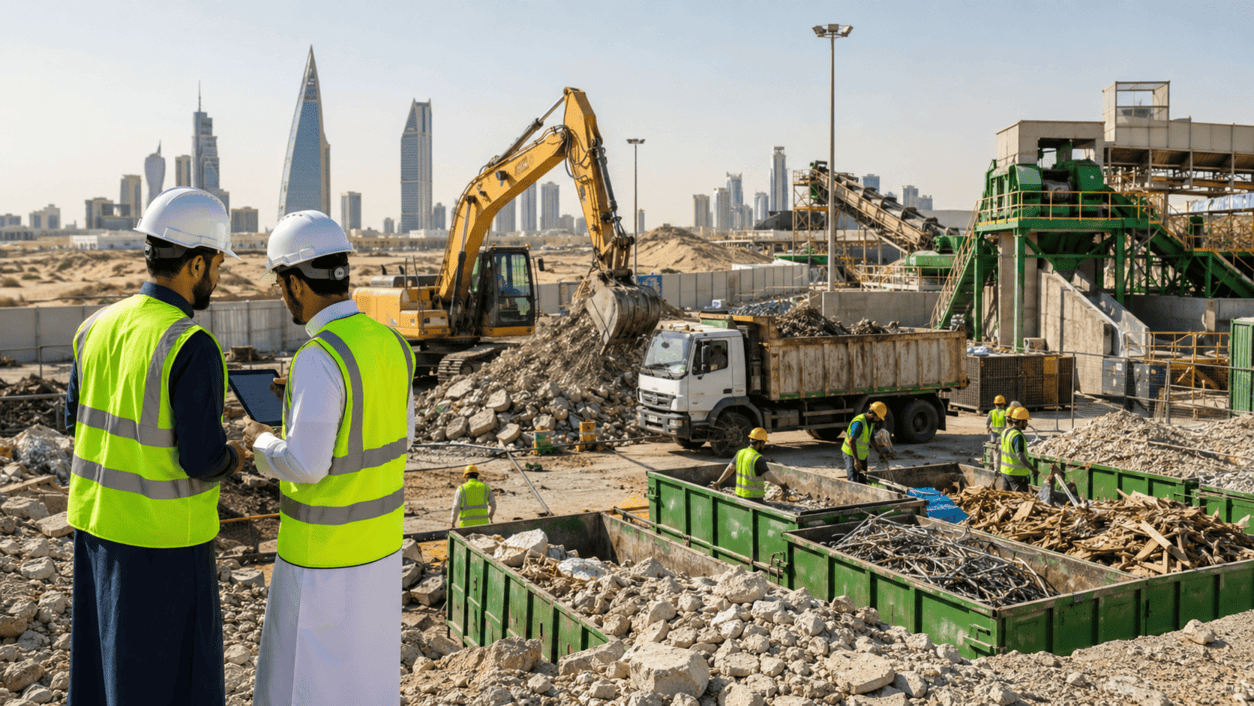
Every new tower, villa compound, and infrastructure project in Saudi Arabia leaves behind a footprint that outlasts the ribbon-cutting: piles of concrete, rebar, brick, plaster, and packaging. Construction and demolition (C&D) waste is one of the largest waste streams in the Kingdom, and under the Waste Management Law it is also one of the most closely regulated. For contractors, developers, and demolition companies, understanding the rules is no longer optional — it directly affects permits, project timelines, and exposure to fines.
1. The Legal Foundation: The Waste Management Law
The Waste Management Law, issued by Royal Decree and a Council of Ministers decision on 13 August 2021 and in force since 14 November 2021, is the cornerstone of everything that follows. Its 38 articles replaced the older 2013 Municipal Solid Waste Management Law and cover the full lifecycle of waste — collection, transport, sorting, storage, treatment, recycling, and final disposal.
The law's Executive Regulation goes further and defines construction and demolition waste explicitly: all solid waste generated by building and infrastructure works, and by the demolition of buildings and structures. That definition matters, because it is what pulls site debris, excavation spoil, and demolition rubble into the same compliance framework as any other regulated waste stream.
2. Who Regulates C&D Waste on Your Site
National Center for Waste Management (MWAN) — established in 2019, MWAN is the primary regulator for all waste activities in the Kingdom, including construction and demolition waste. It licenses collectors, transporters, and treatment facilities, and sets the technical controls each must follow.
Ministry of Municipal and Rural Affairs and Housing (MOMRAH) and local municipalities — issue the demolition permit for each individual property, oversee designated municipal dumping and landfill sites, and set uniform site criteria to protect neighbouring properties and public utilities.
National Center for Environmental Compliance (NCEC) — handles environmental licensing and accreditation for companies offering environmental services connected to waste.
General Authority for Transport — sets vehicle specification and driver safety requirements for hauling waste, working alongside MWAN's own transport controls.
3. Dedicated Technical Controls for C&D Waste
Because construction and demolition waste behaves differently from municipal or industrial waste — high volume, mostly inert, but sometimes hiding hazardous material — MWAN has issued a dedicated package of regulatory and technical guidelines specifically for it, covering collection, transport, sorting, and disposal. These controls make source segregation mandatory rather than optional, and set minimum requirements for everyone in the chain: the producer generating the waste, the transporter moving it, and the recycler or disposal site receiving it. They are meant to be read together with related guidance from MOMRAH and the General Authority for Transport, since vehicle specifications and driver protocols sit at the intersection of both frameworks.
4. Environmental Permits for Larger Projects
Under the waste assessment and management regulation (Council of Ministers Decision No. 69 of 2021), any construction project above a certain size or volume must secure an environmental permit and prepare an Environmental Management Plan (EMP) before work starts on site. The EMP typically addresses dust, noise, and waste handling together, which means your waste strategy needs to be settled well before mobilisation, not improvised once demolition begins.
5. Licensing: The C&D-Specific Collection Permit
A general MWAN license does not automatically cover every activity. Collecting construction and demolition waste requires its own permit — a C&D waste collection permit distinct from the standard MWAN registration. Article 11 of the Waste Management Law sets out what producers must do in practice: reduce waste at the source where possible, reuse materials before treating them as waste, store waste in designated areas, separate what can be recycled, and contract only with MWAN-licensed transporters and operators — with those contracts registered through the national platform.
On top of that, no demolition can legally begin without a permit from the municipality for that specific property, and the transporter carrying the debris away must be under contract to deliver it to the disposal site the municipality has designated — not wherever is closest or cheapest.
6. Hazardous Materials Hiding in “Inert” Waste
Most C&D waste — broken concrete, brick, rebar, aggregate — is inert and comparatively low-risk. But older buildings scheduled for demolition can contain asbestos, lead-based paint, solvents, or other chemical residues. Studies referenced by MWAN's own guidance flag exactly this risk. Material of this kind cannot legally be mixed into general C&D waste; it falls under the law's hazardous waste provisions and needs separate handling, licensed transport, and documented disposal.
7. Penalties for Non-Compliance
Failing to remove construction or demolition waste from a site promptly: SAR 5,000 to SAR 20,000
Dumping construction waste on public land: up to SAR 50,000
Transferring waste to a transporter without verifying their MWAN authorization: up to SAR 10 million
Operating without the required MWAN license or permit: suspension, cancellation, or fines up to SAR 10 million
Criminal penalties (Article 29) for disposal that endangers public health or the environment: up to 10 years' imprisonment, a fine of up to SAR 30 million, or both — with an additional daily fine while the violation continues, and doubled penalties for repeat offenders within three years
8. Vision 2030 and the Push to Recycle
Saudi Arabia generates more than 110 million tonnes of waste a year, and construction debris is one of the largest contributors. The national waste strategy targets diverting 90% of waste from landfill and lifting the recycling rate to 40% by 2040. For C&D waste specifically, that is translating into growing demand for recycled aggregate in road base and non-structural concrete — a real opportunity for contractors who treat debris as a resource to divert rather than a cost to dump.
9. A Practical Compliance Checklist
Secure the demolition or building permit from the municipality before any site work
Confirm your transporter holds both a general MWAN license and the specific C&D collection permit
Segregate waste at source — concrete and masonry, metal, wood, and anything suspected hazardous
Register transport contracts on the national platform and keep manifests on file
Prepare an Environmental Management Plan if the project size triggers the environmental permit requirement
Never dump debris on public land or send it to an undesignated site, even temporarily
Working with a Licensed Partner
For contractors and developers, the fastest way to stay on the right side of this framework is to work with a partner who already lives in it. Zero Waste International Recycling Company Ltd. is a licensed waste management provider serving businesses across Saudi Arabia's industrial, government, and private sectors, with hands-on experience in construction and demolition waste transport, segregation, and disposal — helping you keep projects compliant from permit to final handover.
https://zerowaste.com.sa/services/non-hazardous-waste-transport-disposal
Related Posts

Learn how Saudi businesses can safely manage industrial waste removal, including hazardous waste cla...
Choosing a waste management company in Saudi Arabia is not a procurement decision you can make on pr...
Saudi Arabia's FMCG sector is one of the largest and fastest-growing consumer markets in the Middle...