
Hazardous Waste Management in Saudi Arabia's Oil & Gas Sector
-
Home
-
Waste Removal
-
Hazardous Waste
-
Hazardous Waste Management in Saudi Arabia's Oil & Gas Sector
Hazardous Waste Management in Saudi Arabia's Oil & Gas Sector
Hazardous waste management in Saudi Arabia's energy sector has entered a new era. The 2021 Waste Management Law, MWAN's expanding licensing and enforcement apparatus, and Vision 2030's sustainability targets have fundamentally changed what is expected of oil and gas operators, service contractors, and industrial facility managers.

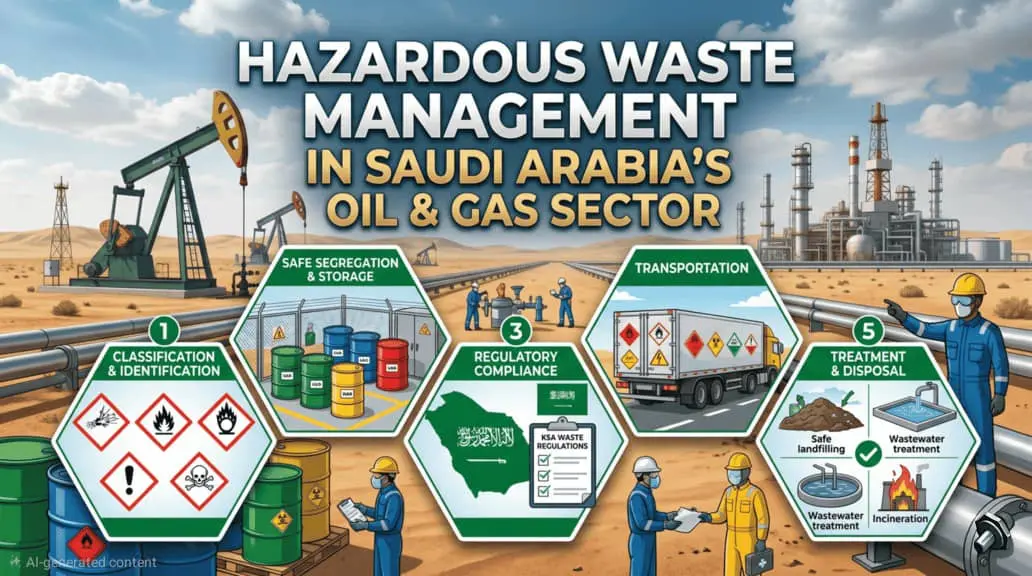
Saudi Arabia's oil and gas sector is the engine of the Kingdom's economy — and one of its most significant generators of hazardous waste. For every barrel of crude lifted, refined, and transported, a complex array of toxic, flammable, reactive, and corrosive byproducts is produced. Managing these materials safely and legally is not just an environmental obligation — it is a business-critical risk that the Kingdom's evolving regulatory framework is making impossible to ignore.
Hazardous waste management in Saudi Arabia's energy sector has entered a new era. The 2021 Waste Management Law, MWAN's expanding licensing and enforcement apparatus, and Vision 2030's sustainability targets have fundamentally changed what is expected of oil and gas operators, service contractors, and industrial facility managers. This guide is a comprehensive resource for every stakeholder in the KSA oil and gas value chain who needs to understand their obligations, their risks, and how to manage hazardous waste effectively and compliantly.
1. The Scale of Hazardous Waste in Saudi Arabia's Oil & Gas Sector
Saudi Arabia is the world's largest crude oil exporter, operating one of the densest networks of wells, pipelines, refineries, and petrochemical plants in the world. This industrial scale generates correspondingly significant volumes of hazardous waste.
Industry data illustrates the challenge: hazardous waste already represents an estimated 70% of all industrial waste generated in the Kingdom in 2024 — driven predominantly by the oil and gas, chemicals, and petrochemical sectors. The Middle East hazardous waste management market was valued at USD 677 million in 2024, with Saudi Arabia commanding a 36.4% share — the largest of any country in the region. This market is projected to grow at a CAGR of 7.0% through 2033, driven by tightening regulations and expanding industrial output.
The sources of hazardous waste across the oil and gas value chain are numerous and varied:
Upstream exploration and production: drilling muds, drill cuttings, produced water, wellbore completion chemicals, stimulation fluids
Midstream transport and storage: pipeline pigging waste, storage tank sludge, oily water from separator systems, cathodic protection materials
Downstream refining and petrochemicals: spent catalysts, chemical process waste, acid sludge, caustic effluents, hydrocarbon residues
Maintenance and operations across the value chain: contaminated PPE, spent lubricants, used filters and absorbents, chemical containers, NORM-affected equipment
A defining feature of oilfield hazardous waste is its complexity: each waste stream has a distinct chemical composition, regulatory classification, handling requirement, and disposal pathway. A single-size approach to management is not adequate — and in Saudi Arabia, it is not legal.
2. Classifying Hazardous Waste in KSA Oil & Gas Operations
The Saudi Waste Management Law defines hazardous waste as waste generated from industrial or non-industrial activities that contains toxic, flammable, reactive, or corrosive materials — including solvents, degreasers, oils, dyes, pigments, acids, and alkalis. For oil and gas operators, virtually every major waste stream falls within this definition. Here is a breakdown of the most significant categories:
Oil-Based Drill Cuttings (OBDCs)
When oil-based drilling mud is used during well construction, the rock fragments (cuttings) brought to surface are coated with residual oil — making them classified as hazardous waste under Saudi regulations. Approximately 250 cubic metres of drill cuttings are generated per well during the drilling process. OBDCs contain petroleum hydrocarbons including BTEX compounds, heavy metals, and potentially naturally occurring radioactive materials (NORM), requiring specialized treatment before disposal.
Oily Sludge
Oily sludge is one of the most challenging hazardous waste streams in the petroleum industry. It is generated at multiple points across the value chain: at oilfield pits (from spilled crude and drilling operations), in crude oil storage tanks (as tank bottom sludge), in refinery wastewater treatment systems, and in heat exchanger cleaning operations. Oily sludge is a complex emulsion of hydrocarbons, water, solid particles, heavy metals, and chemical additives — difficult to treat and regulated as hazardous across all major international frameworks.
Produced Water
Produced water is the largest byproduct stream of oil and gas production — globally, around three barrels of produced water are generated for every barrel of oil. It contains dissolved hydrocarbons, heavy metals, radionuclides, naturally occurring radioactive material (NORM), salts, biocides, scale inhibitors, and other production chemicals. Its composition varies by formation geology and well age. Produced water that is improperly discharged or stored constitutes hazardous waste under KSA law and must be managed by licensed service providers.
NORM-Affected Equipment and Scale
Naturally occurring radioactive materials (NORM) are brought to the surface as a byproduct of oil and gas production. They accumulate in pipe scale, equipment surfaces, storage tanks, and produced water sludge as radium-226 and radium-228 — decay products of uranium and thorium present in the geological formation. NORM-contaminated equipment and scale are classified as hazardous and subject to specific handling, transport, and disposal protocols that go beyond standard hazardous waste management.
Spent Chemicals and Process Waste
Oil and gas operations use large volumes of production chemicals — corrosion inhibitors, demulsifiers, biocides, scale inhibitors, and stimulation fluids. Spent or off-spec chemicals, contaminated chemical containers, and chemical sludge residues are classified as hazardous waste. So are spent catalysts from refinery hydrotreating and fluid catalytic cracking (FCC) units, which can contain heavy metals including nickel, vanadium, and molybdenum.
Contaminated Personal Protective Equipment (PPE) and Absorbents
PPE exposed to hazardous substances — including gloves, suits, respirators, and boots — as well as absorbent pads, spill cleanup materials, and oil-saturated rags are classified as hazardous waste when contaminated with petroleum hydrocarbons, chemicals, or NORM. Their volumes are often underestimated on large oilfield operations, but their mismanagement can create significant regulatory liability.
3. Saudi Arabia's Regulatory Framework for Hazardous Waste in Oil & Gas
Saudi Arabia has built one of the most comprehensive hazardous waste regulatory frameworks in the Gulf region. For oil and gas operators, compliance is multi-layered — involving national law, sector-specific regulations, and industrial city standards.
The Waste Management Law (2021) — Core Obligations
The 2021 Waste Management Law is the governing instrument for all hazardous waste activities in the Kingdom. For oil and gas operators and their contractors, the law establishes specific obligations that go beyond general waste management requirements:
Separate hazardous waste at the point of generation — mixing hazardous and non-hazardous waste streams is a violation
Store hazardous waste only in designated, approved locations that comply with MWAN's environmental controls
Use only MWAN-licensed service providers for all hazardous waste transportation and disposal
Ensure that all hazardous waste documentation is available and accurate — manifests, transport records, waste characterization reports
Notify the competent authority of all hazardous waste transport routes — and of any changes to those routes
Ensure that hazardous waste transport vehicles do not pass through residential areas or city centres during restricted hours
Notify the competent authority of vehicle parking locations for hazardous waste transport
Wash and disinfect hazardous waste transport vehicles after each use, in coordination with the competent authority
Submit periodic compliance reports to MWAN on all hazardous waste generation, transport, treatment, and disposal activities
MWAN Licensing — No Activity Without Authorization
No hazardous waste management activity may be conducted in Saudi Arabia without a license from the National Center for Waste Management (MWAN). This applies separately to collection, transportation, storage, treatment, and disposal — meaning a contractor licensed for transportation cannot legally conduct treatment or disposal without additional licenses. For oil and gas operators that generate hazardous waste, the law also places direct responsibility on you to verify that any service provider you engage holds valid, current MWAN authorization. Engaging an unlicensed contractor is itself a violation carrying fines of up to SAR 10 million.
Saudi Aramco and Major Operator HSE Standards
Beyond the national regulatory framework, oil and gas operators in Saudi Arabia — and their contractors — must comply with company-level HSE management systems. Saudi Aramco's General Instructions (GIs), Safety Management System, and Contractor Safety Management Program impose detailed requirements for hazardous waste handling, contractor qualification, waste manifest documentation, and emergency response that in many cases exceed the requirements of national law.
Royal Commission Environmental Regulations (RCER) in Jubail and Yanbu
Companies operating in Royal Commission-administered industrial cities must comply with the RCER-2015 environmental standards in addition to national law. These include specific requirements for hazardous waste identification, classification, storage, transport, and disposal, along with reporting obligations and emergency response protocols.
International Conventions
Saudi Arabia is a signatory to several international environmental agreements relevant to hazardous waste in oil and gas: the Basel Convention on the control of transboundary movements of hazardous wastes, the Stockholm Convention on persistent organic pollutants, and the Rotterdam Convention on prior informed consent for certain hazardous chemicals. These international obligations are reflected in Saudi domestic law and restrict import, export, and transboundary movement of hazardous waste.
4. Penalties for Non-Compliance — What Operators and Contractors Risk
The 2021 Waste Management Law imposes some of the harshest environmental penalties in the Gulf region. For oil and gas operators, the risk is compounded by the sheer volume and variety of hazardous waste streams — more touchpoints mean more opportunities for violations, and repeat violations are penalised at double the base rate.
The key penalty provisions that oil and gas operators must understand:
Improper disposal, storage, burning, or treatment of waste that poses a risk to public health or the environment: imprisonment up to 10 years and/or a fine up to SAR 30 million (approximately USD 8 million)
Daily fine of up to 10% of the base fine for each day a violation continues
Transferring hazardous waste to an unlicensed service provider: up to SAR 10 million
Failure to separate hazardous waste at source: SAR 10,000 to SAR 100,000
Operating without an MWAN license: suspension, cancellation, or fines up to SAR 10 million
All penalties doubled for repeat violations within three years
Courts may also confiscate equipment used in violations and impose ongoing daily fines until the violation is corrected
Beyond financial penalties, non-compliant operators and contractors face contract disqualification from Saudi Aramco and other major operators, suspension of MWAN licenses, reputational damage that affects future tendering, and personal criminal liability for responsible individuals.
5. The Hazardous Waste Management Lifecycle — Best Practice for KSA Oil & Gas Sites
Effective hazardous waste management in Saudi Arabia's oil and gas sector requires a disciplined, documented approach across the full waste lifecycle:
Step 1 — Waste Identification and Characterization
Every waste stream must be identified by source, composition, and physical properties before it can be correctly classified, stored, or transported. This involves laboratory analysis for key parameters — total petroleum hydrocarbons, BTEX, heavy metals, pH, flash point, reactivity, NORM content — and comparison against MWAN's classification criteria. Accurate characterization is the foundation of all subsequent steps.
Step 2 — Segregation at Source
Saudi law requires hazardous and non-hazardous waste to be separated at the point of generation. On oilfield sites, this means maintaining separate, clearly labelled storage areas for different waste categories — oil-based drill cuttings, oily water, spent chemicals, contaminated PPE, and general non-hazardous waste. Mixing waste streams is a violation and can elevate the regulatory classification of otherwise non-hazardous waste.
Step 3 — Compliant On-Site Storage
Hazardous waste must be stored in MWAN-approved containers and designated areas that meet Saudi environmental controls. Storage areas must be clearly identified, physically contained to prevent leaks and spills, have secondary containment, and be inventoried. Time limits may apply to storage before disposal is required. On-site storage is a common area for violations — and a frequent trigger for regulatory inspections.
Step 4 — Documentation and Manifest System
Every movement of hazardous waste — from the point of generation to its final disposal — must be accompanied by correct documentation. Saudi Arabia is developing an electronic waste transport document system under MWAN that will enable end-to-end tracking from source to final destination, enhancing regulatory oversight and creating an auditable chain of custody. Oil and gas operators must maintain all waste manifests, transport records, and characterization reports — and be prepared to produce them on regulatory request.
Step 5 — Licensed Transportation
Hazardous waste transport in Saudi Arabia requires dedicated MWAN-licensed vehicles equipped with appropriate containment systems, warning labels, and emergency response equipment. Drivers must be trained in hazardous materials handling. Routes must be pre-notified to competent authorities, and vehicles must avoid residential areas during restricted periods. Post-transport washing and disinfection of vehicles is a legal requirement.
Step 6 — Approved Treatment and Disposal
Treatment and disposal methods for specific hazardous waste types must be approved by MWAN. Common treatment pathways for oilfield hazardous waste include thermal desorption for oil-contaminated drill cuttings, incineration for spent chemicals and contaminated PPE, deep well injection for certain liquid waste streams, and stabilization/solidification for heavy metal-contaminated sludge before landfill disposal. All facilities used must be MWAN-licensed, and all disposal must comply with Saudi environmental protection standards.
Step 7 — Periodic Regulatory Reporting
Oil and gas operators and their waste service contractors are legally required to submit periodic reports to MWAN on all hazardous waste generation, transport, treatment, and disposal activities. These reports are part of Saudi Arabia's expanding regulatory oversight infrastructure — and their accurate submission is both a legal obligation and a demonstration of organizational compliance maturity.
6. Vision 2030 and the Changing Landscape for Oil & Gas Waste
Saudi Arabia's Vision 2030 is driving structural change in how the Kingdom manages its industrial environmental footprint — and hazardous waste from the oil and gas sector is squarely in scope.
MWAN's National Waste Management Strategy has identified the need for more than 800 new waste management and resource recovery facilities across the Kingdom. Investment opportunities in the sector are estimated at SAR 420 billion by 2040, with significant private sector participation expected. In industrial cities like Jubail and Yanbu — home to a significant proportion of the Kingdom's refining and petrochemical capacity — treatment infrastructure for hazardous waste is already being expanded.
MWAN is also deploying an electronic waste transport document system that will enable real-time tracking of hazardous waste movements from source to final destination. This digital infrastructure will significantly increase the transparency and traceability of hazardous waste management — and raise the stakes of non-compliance for any operator whose waste movements are not properly documented.
The direction of travel is clear: Saudi Arabia is building the regulatory infrastructure and enforcement capability to ensure that hazardous waste generated by its oil and gas sector is managed to world-class environmental standards. Companies that invest in compliance today will be ahead of the curve. Those that do not will find the cost of non-compliance rising sharply.
7. How to Choose a Hazardous Waste Partner for Your Oil & Gas Operations in KSA
For oil and gas operators, the choice of hazardous waste management partner is one of the highest-stakes vendor decisions in their environmental and compliance programme. Here is what separates a trustworthy, compliant partner from a liability risk:
Verified MWAN licensing across all relevant activities
Confirm that your contractor holds MWAN licenses covering every activity in your waste management chain — not just transport, but also treatment and disposal for each specific waste type you generate. Request current license documentation and cross-check with MWAN's licensed entities database, which now counts 1,348 licensed entities in the Kingdom.
Demonstrated oilfield waste expertise
Managing drill cuttings, oily sludge, produced water residues, and NORM-affected materials requires specific technical knowledge that general waste contractors do not have. Ask for documented case studies, site references, and technical capability statements demonstrating experience with oil and gas hazardous waste streams in KSA specifically.
Robust documentation and chain of custody
A compliant hazardous waste partner maintains meticulous records of every waste movement — generator identification, waste characterization, transport manifest, treatment method, and final disposal certificate. Your contractor's documentation is your legal protection. Verify their records management system before signing any contract.
Emergency response capability
Oil and gas operations carry an inherent risk of accidental spills, leaks, and unexpected waste generation events. Your hazardous waste partner should have the equipment, trained personnel, and response protocols to react quickly and compliantly to emergency situations — minimizing environmental harm and regulatory exposure.
Compliance with operator-level HSE programmes
If you operate under Saudi Aramco's Contractor Safety Management Program or similar frameworks, your waste contractor must be able to demonstrate compliance with the specific requirements of those programmes. Verify that your partner has the documentation, training records, and management systems to qualify and remain compliant.
Zero Waste International Company Ltd. is a licensed hazardous and non-hazardous waste management provider serving Saudi Arabia's oil and gas, power, ports, and industrial sectors. Our services span the complete hazardous waste lifecycle: industrial hazardous waste transport and disposal, contaminated soil cleaning and transport, tank cleaning and sludge removal, super sucker services, and equipment rental. We provide the documentation, chain of custody, and regulatory compliance your operations demand — backed by proven sector experience.
Related Posts
Learn how Saudi businesses can safely manage industrial waste removal, including hazardous waste cla...
How Saudi Arabia regulates construction and demolition waste in 2026 — the Waste Management Law, MWA...
Choosing a waste management company in Saudi Arabia is not a procurement decision you can make on pr...