

Contaminated Soil Remediation: A Complete Guide for Oil & Gas Sites in KSA
-
Home
-
Environment
-
Contaminated Soil Remediation: A Complete Guide for Oil & Gas Sites in KSA
Contaminated Soil Remediation: A Complete Guide for Oil & Gas Sites in KSA
For any oil and gas operator, contractor, or industrial facility manager in the Kingdom, understanding how contaminated soil remediation works — and what the law requires — is no longer optional. This guide covers everything: the science of contamination, Saudi-specific regulations, the remediation techniques used on oilfield sites, and how to select a compliant service partner.

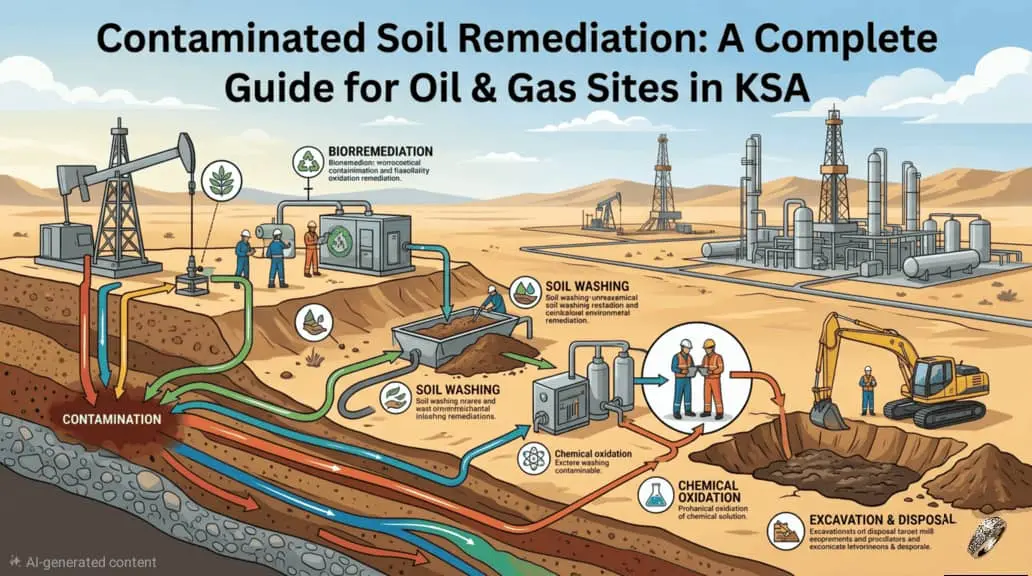
Saudi Arabia is the world's largest oil exporter. Decades of exploration, drilling, refining, and pipeline operations have made hydrocarbon soil contamination one of the Kingdom's most pressing industrial environmental challenges — and the regulatory framework for addressing it has never been stricter.
For any oil and gas operator, contractor, or industrial facility manager in the Kingdom, understanding how contaminated soil remediation works — and what the law requires — is no longer optional. This guide covers everything: the science of contamination, Saudi-specific regulations, the remediation techniques used on oilfield sites, and how to select a compliant service partner.
1. Why Oil & Gas Sites in Saudi Arabia Face a Unique Contamination Challenge
Saudi Arabia's hydrocarbon industry is vast. The Kingdom holds approximately 17% of the world's proven oil reserves and operates one of the most extensive pipeline and refining networks in the Middle East. This scale creates an equally significant environmental footprint.
Several characteristics make soil contamination in KSA oil and gas environments particularly complex:
Arid, low-permeability soil
Saudi Arabia's desert soils are generally low in organic matter and microbial activity, which means natural attenuation — the environment's own ability to break down contaminants over time — is far slower than in temperate regions. Petroleum hydrocarbons introduced into arid soils can persist for decades without intervention.
Groundwater vulnerability
Despite the Kingdom's arid climate, groundwater aquifers supply a significant proportion of water for industrial and agricultural use. Because Saudi Arabia has limited renewable freshwater resources, even localized soil contamination can threaten aquifer quality across wide areas. Contamination that reaches the water table is significantly harder and costlier to remediate than surface-level pollution.
Scale of produced water
For every barrel of oil extracted, oilfield operations generate an average of three barrels of produced water — a byproduct of reservoir flushing that contains dissolved hydrocarbons, heavy metals, salts, and other pollutants. A proportion of this produced water is discharged into the surrounding environment, contributing to soil and groundwater contamination on an ongoing basis.
Legacy contamination
Decades of oilfield operations, pipeline incidents, and storage tank leaks have left behind significant legacy contamination at many sites across the Eastern Province, Jubail, and other industrial zones. Many of these sites are only now being assessed and remediated under Saudi Arabia's increasingly stringent environmental framework.
2. The Most Common Soil Contaminants at Saudi Oil & Gas Sites
Understanding what you are dealing with is the first step in any remediation project. The contaminants found at Saudi oil and gas sites typically fall into three broad categories:
Petroleum Hydrocarbons (PHCs)
The most widespread contaminant class in oilfield environments. PHCs include total petroleum hydrocarbons (TPH), benzene, toluene, ethylbenzene, and xylene (collectively known as BTEX compounds), as well as polycyclic aromatic hydrocarbons (PAHs). These compounds are toxic to humans and ecosystems, with several BTEX components classified as carcinogens. PHCs enter the soil through pipeline leaks, storage tank failures, drilling fluid spills, and produced water discharge.
Heavy Metals
Oil and gas operations introduce a range of heavy metals into the soil environment. Common contaminants include iron, aluminum, lead, chromium, arsenic, zinc, cadmium, and mercury. Sources include drilling equipment corrosion, well-head rust, drilling mud formulations, and produced water. Heavy metals are persistent — they do not break down naturally — and can accumulate in the food chain, posing long-term risks to human health.
Drilling Fluids and Mud
Drilling mud is used to lubricate and cool drill bits, control wellbore pressure, and carry cuttings to the surface. When spilled or improperly disposed of, water-based and oil-based drilling muds introduce a complex mixture of chemicals, hydrocarbons, heavy metals, and salts into the surrounding soil. Oil-based drilling muds in particular are classified as hazardous waste under Saudi regulations.
Produced Water Constituents
Produced water contains dissolved and dispersed oil components, naturally occurring radioactive materials (NORM), salts, heavy metals, scale inhibitors, biocides, and other production chemicals. When discharged into the environment — whether from leaks or inadequate containment — these constituents contaminate soil and threaten groundwater quality.
3. Saudi Arabia's Regulatory Framework for Soil Contamination
Saudi Arabia now has one of the most comprehensive soil pollution regulatory frameworks in the Gulf region. Understanding your legal obligations is essential before any remediation project begins.
The Environmental Law (2020) and its Implementing Regulations
Saudi Arabia's current Environmental Law was issued by Royal Decree No. 165 in 2020 and came into effect in January 2021. It sets the overarching framework for environmental protection and mandates compliance with environmental specifications, standards, and guidelines for all projects that may affect the environment. The law introduced significant penalties for soil contamination, including fines and imprisonment for serious violations.
The Executive Regulation for the Prevention and Remediation of Soil Pollution
This MEWA regulation is the most directly relevant instrument for businesses dealing with contaminated soil. It sets protection standards for soil quality, remediation requirements for polluted sites, site monitoring protocols, and penalties for violations. Key obligations include:
Notifying the National Center for Environmental Compliance (NCEC) as soon as soil pollution is detected during any activity — this is a legal requirement under Article 7 of the Regulation
Cooperating with NCEC to limit the spread of contamination and prevent further pollution
Implementing a remediation plan approved by the competent authority
Meeting post-remediation soil quality standards before a site can be released for reuse
Paying compensation for environmental damage caused, including all rehabilitation costs
The Executive Regulations for Environmental Rehabilitation of Degraded Sites
This complementary regulation governs the rehabilitation of sites that have experienced environmental degradation, including industrial sites contaminated by long-term oilfield operations. It sets requirements for site assessment, remediation planning, implementation monitoring, and post-remediation verification.
Royal Commission Environmental Regulations (RCER) in Industrial Cities
Businesses operating in Jubail, Yanbu, and other Royal Commission-managed industrial cities must also comply with the RCER-2015 standards, which include detailed requirements for soil and groundwater investigation following Phase I and Phase II Environmental Site Assessment protocols aligned with ASTM international standards.
Under Article 7 of the Executive Regulation for Soil Pollution Prevention, it is prohibited to withhold notification to authorities when soil pollution is detected during any activity. Failure to report is itself a regulatory violation — separate from the contamination itself.
4. The Remediation Process: From Assessment to Clearance
Effective contaminated soil remediation is a structured, multi-stage process. For oil and gas sites in Saudi Arabia, the following steps reflect both international best practice and KSA regulatory requirements:
Stage 1: Phase I Environmental Site Assessment (ESA)
A Phase I ESA is a desktop and walkover review designed to identify recognized environmental conditions (RECs) at a site. It involves reviewing historical records, satellite imagery, operational logs, and spill histories, followed by a site walkover inspection. A Phase I does not involve soil sampling but flags areas requiring further investigation.
Stage 2: Phase II ESA — Soil and Groundwater Investigation
Where a Phase I identifies RECs, a Phase II ESA is carried out. This involves collecting soil and groundwater samples from targeted locations and depths, and having them analyzed in accredited laboratories for the relevant contaminants (TPH, BTEX, PAHs, heavy metals, etc.). The Phase II establishes the nature and extent of contamination and informs the design of the remediation plan.
Stage 3: Conceptual Site Model (CSM) and Risk Assessment
A CSM maps the relationship between contamination sources, the pathways through which pollutants move (surface water, groundwater, vapour), and the receptors at risk (workers, communities, aquifers, ecosystems). A risk assessment quantifies the actual threat posed by the contamination, which determines how clean the soil needs to be — the remediation targets.
Stage 4: Remediation Design and Technology Selection
Based on the CSM, risk assessment, and site-specific factors, the appropriate remediation technology — or combination of technologies — is selected. The remediation plan must be approved by the relevant competent authority before work begins.
Stage 5: Remediation Implementation
The approved remediation plan is executed under the supervision of qualified environmental professionals, with ongoing monitoring to confirm the approach is achieving the required results.
Stage 6: Verification and Regulatory Sign-Off
Post-remediation soil and groundwater sampling confirms that cleanup targets have been met. A verification report is submitted to the relevant authority, and the site can be released for its intended future use.
5. Remediation Technologies Used at Oilfield Sites in KSA
The choice of remediation technology depends on the type and concentration of contaminants, the soil type, site constraints, timeline, and budget. Here are the main technologies applicable to oil and gas contamination in Saudi Arabia:
Excavation and Ex-Situ Treatment
The most straightforward approach: physically remove contaminated soil from the site and transport it to an approved treatment facility. This approach is effective for well-defined, near-surface contamination zones where in-situ treatment is impractical. Excavated soil may be treated by thermal desorption, soil washing, or stabilization/solidification at an off-site facility before approved disposal. This is Zero Waste International's core service for contaminated soil — providing end-to-end management from excavation through certified transport to treatment and disposal.
Bioremediation
Bioremediation uses naturally occurring microorganisms to break down petroleum hydrocarbons in soil into less harmful compounds. Research conducted across KSA has identified more than 30 bacterial genera capable of degrading complex hydrocarbon compounds, including PAHs. Bioremediation is considered the most environmentally sustainable approach to hydrocarbon-contaminated soil and is highly cost-effective compared to physical or chemical methods — but it requires adequate moisture, nutrients, and oxygen, which must be carefully managed in Saudi Arabia's arid conditions.
Thermal Desorption
Contaminated soil is heated to high temperatures to volatilize and remove petroleum hydrocarbons and other volatile organic compounds. Low-temperature thermal desorption (90–320°C) is effective for fuel hydrocarbons; high-temperature desorption (320–560°C) targets heavier compounds and PAHs. The volatilized contaminants are captured and treated before release. This is one of the most effective technologies for oilfield PHC contamination but requires significant energy input.
Soil Washing and Chemical Treatment
Water-based or chemical solutions are applied to contaminated soil to dissolve and flush out contaminants. Soil washing is particularly effective for heavy metal contamination and for coarse-grained soils (sands and gravels) that are prevalent in Saudi Arabia's Eastern Province. Chemical treatment can also neutralize specific contaminants — for example, oxidation to break down complex hydrocarbons.
Stabilization and Solidification
Binders such as cement, lime, or fly ash are mixed with contaminated soil to immobilize contaminants and reduce their mobility and leachability. This approach does not destroy contaminants but contains them within a stable matrix, reducing exposure risk. It is commonly used for heavy-metal-contaminated soils where complete removal is not feasible.
Containment and Capping
For sites where full remediation is not immediately feasible, engineered containment systems — including physical barriers and low-permeability surface caps — can isolate contaminated soil from receptors and prevent further leaching into groundwater. This is a risk-management approach rather than a full cleanup solution, and it requires ongoing monitoring.
6. Choosing the Right Remediation Partner for Your KSA Site
Soil remediation on oil and gas sites in Saudi Arabia is a highly specialized activity. The consequences of doing it wrong — regulatory penalties, extended liability, reputational damage, and ongoing environmental harm — are serious. Here is what to look for in a remediation contractor:
NCEC accreditation and MWAN licensing
Any company providing environmental services related to contaminated soil must hold the relevant authorizations from Saudi regulatory bodies. Ask for documentation and verify independently.
Oilfield sector experience
Soil contamination in oil and gas environments is categorically different from general industrial waste management. Insist on demonstrated experience with hydrocarbon-contaminated sites, drilling waste, produced water constituents, and NORM-affected soil in KSA specifically.
End-to-end service capability
Remediation projects on live operational sites demand full coordination — from initial site assessment through excavation, transport, treatment, and final disposal. Fragmenting this across multiple contractors creates compliance gaps and accountability risks. A single licensed provider managing the full chain is significantly safer.
Proper transportation authorization
Excavated contaminated soil from oilfield sites is classified as hazardous waste. Its transport requires MWAN-licensed vehicles, proper documentation, approved routing, and manifests that trace the waste from source to disposal. Verify that your contractor holds transport authorization — not just treatment or disposal permits.
Regulatory reporting and documentation
Your remediation contractor should produce all documentation required for regulatory submissions — investigation reports, remediation plans, progress monitoring data, and verification reports. This documentation protects your business in the event of an audit or enforcement action.
Zero Waste International Company Ltd. provides specialized contaminated soil cleaning and transport services for oil and gas sites across Saudi Arabia. Our certified team manages the complete remediation process — from initial site assessment and excavation through compliant hazardous waste transport to approved treatment and disposal — helping your operations meet KSA environmental obligations efficiently and safely.
Related Posts
Learn how Saudi businesses can safely manage industrial waste removal, including hazardous waste cla...
How Saudi Arabia regulates construction and demolition waste in 2026 — the Waste Management Law, MWA...

Choosing a waste management company in Saudi Arabia is not a procurement decision you can make on pr...